
Water quality has become a major concern for industries, commercial buildings, residential societies, and institutions. Whether the source is groundwater, municipal supply, or surface water, untreated water can create problems like scaling, bad taste, corrosion, and equipment damage. Choosing the right purification solution depends on the type of water problem you are facing.
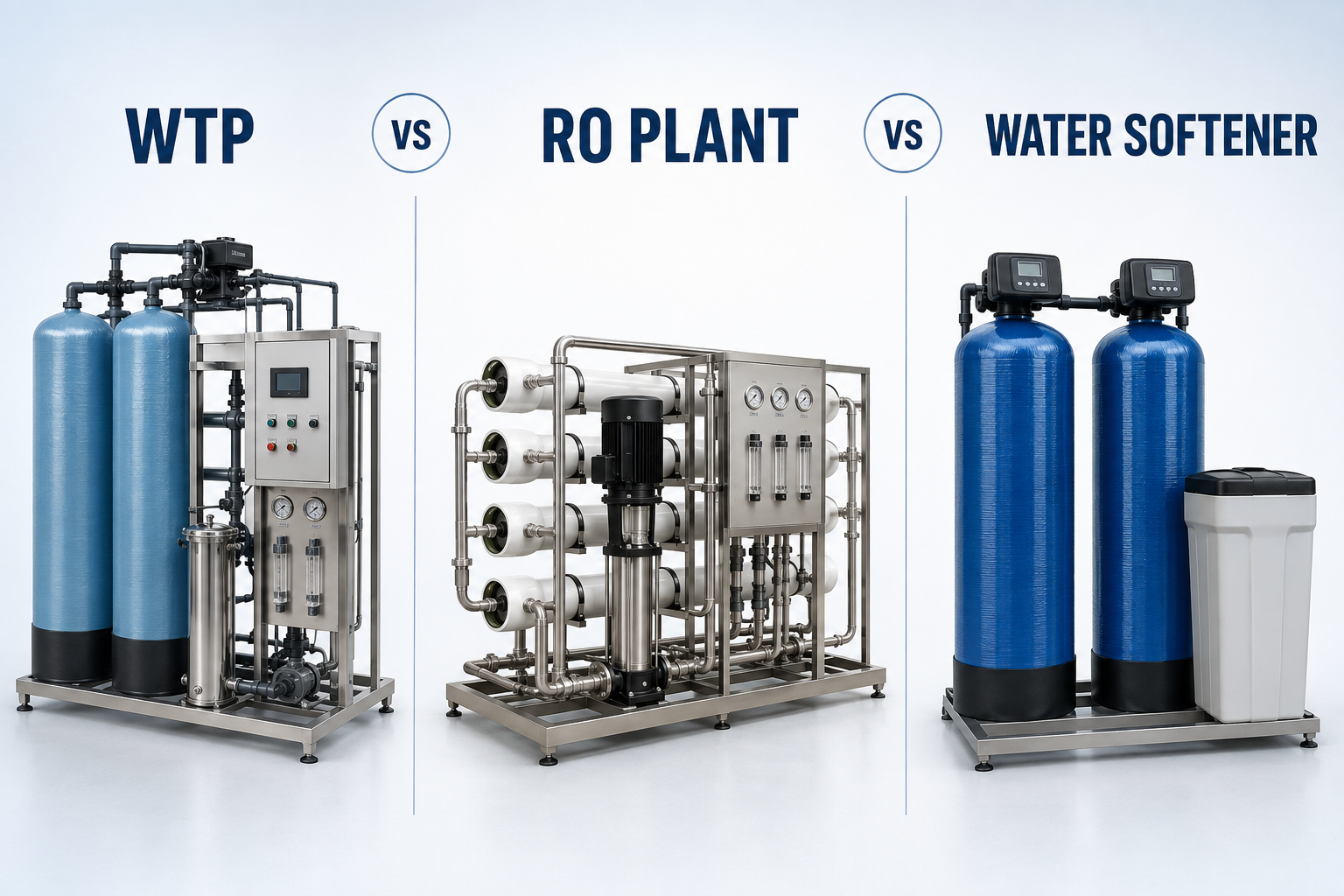
Water Treatment Plant Services in Bangalore provide customized solutions for different water quality challenges, but many people get confused while selecting between different treatment systems. The most common confusion is between a WTP vs RO plant because both systems are used for water treatment but serve different purposes. Similarly, water softeners have a specific role in controlling hardness and protecting pipelines and equipment.
Understanding the working, benefits, and applications of each system will help you make the right decision for your water treatment needs.
Call or WhatsApp: +91 96061 71055
What Is a Water Treatment Plant (WTP)?
A Water Treatment Plant (WTP) is a complete system designed to treat contaminated or untreated water and make it suitable for specific applications. A WTP generally focuses on removing physical, chemical, and biological impurities from water.
Depending on the water source and quality, a WTP may include processes such as:
- Filtration
- Sedimentation
- Coagulation and flocculation
- Disinfection
- Removal of suspended particles
- Chemical treatment
WTP systems are commonly used in industries, housing societies, hotels, hospitals, and commercial facilities where large quantities of water need to be treated.
For example, if your water source is a borewell, the water may contain high levels of iron, turbidity, organic matter, and other contaminants. A properly designed borewell water treatment system can help remove these impurities and improve overall water quality.
What Is an RO Plant?
A Reverse Osmosis (RO) Plant is an advanced purification system that uses a semi-permeable membrane to remove dissolved salts, minerals, and impurities from water. RO technology is highly effective for reducing Total Dissolved Solids (TDS), heavy metals, and other dissolved contaminants.
RO plants are widely used where high-quality purified water is required, such as:
- Pharmaceutical industries
- Food and beverage units
- Laboratories
- Commercial buildings
- Drinking water facilities
A commercial water purification system based on RO technology is designed to deliver safe and purified water in large volumes while maintaining consistent quality.
Understanding the Difference: WTP vs RO Plant
The choice between these two systems depends mainly on the quality of incoming water and the required output quality.
1. Treatment Process
A WTP generally removes suspended impurities, microorganisms, and certain chemical contaminants through multiple treatment stages. It is suitable for improving overall water quality.
An RO plant works differently by forcing water through a membrane that separates dissolved impurities from purified water.
When comparing WTP vs RO plant, it is important to understand that one system does not always replace the other. In many industrial applications, both systems are installed together to achieve complete water purification.
2. Purpose of Treatment
A WTP is mainly used for making raw water suitable for general usage, industrial processes, or further treatment.
An RO plant is used when the requirement is high-purity water with reduced TDS levels.
For example:
- A manufacturing facility may use a WTP for initial treatment and an RO plant for final purification.
- A residential society may use filtration and softening systems depending on water quality.
- A drinking water facility may require RO purification for safe consumption.
3. Water Quality Requirements
The selection depends on what impurities are present in the water.
If the main issues are:
- Mud or suspended particles
- Odour
- Microorganisms
- Colour
A WTP may be the right choice.
If the problem is:
- High TDS
- Salinity
- Heavy metals
- Dissolved impurities
An RO plant is generally more suitable.
What Is a Water Softener?
A water softener is a system specifically designed to reduce water hardness. Hard water contains high amounts of calcium and magnesium, which can cause scaling in pipes, boilers, heaters, and industrial equipment.
A water softener works through an ion exchange process where hardness-causing minerals are replaced with sodium ions.
Water softeners are commonly used in:
- Hotels
- Laundries
- Industries
- Apartments
- Heating and cooling systems
A softener does not remove all dissolved impurities like an RO system. Its primary function is hardness control.
Water Softener vs RO Plant: Which One Is Better?
The answer depends on your water problem.
A water softener is suitable when hardness is the main concern. It helps protect equipment, improves cleaning efficiency, and reduces scale formation.
An RO plant is suitable when you need to reduce TDS and remove dissolved contaminants.
The comparison of water softener vs RO plant is not about which system is better, but about which system matches your requirement.
In some cases, both systems are used together. A softener can protect the RO membrane by reducing hardness, improving the efficiency and life of the RO system.
Water Treatment Plant vs RO Plant: Key Differences
Many industries evaluate water treatment plant vs RO plant before installing a purification system. The right choice depends on factors like water source, application, and budget.
| Feature | Water Treatment Plant | RO Plant |
| Main Function | Removes suspended and biological impurities | Removes dissolved salts and contaminants |
| Technology | Filtration and chemical processes | Membrane-based purification |
| Suitable For | Raw water treatment | High-purity water requirement |
| Removes TDS | Limited | Highly effective |
| Applications | Industries, societies, commercial facilities | Drinking water, pharma, laboratories |
Factors to Consider Before Selecting a Water Treatment System
Before installing any system, consider the following points:
1. Water Testing Report
A water analysis report is the first step. It helps identify hardness, TDS, pH level, iron content, and other impurities.
2. Water Source
The treatment requirement changes depending on whether the water comes from:
- Borewell
- Municipal supply
- River or surface water
3. Daily Water Requirement
Small commercial requirements and large industrial requirements need different system capacities.
4. End Application
The required water quality for drinking, manufacturing, cleaning, or processing will determine the right technology.
5. Maintenance Requirements
Every treatment system requires regular maintenance, filter replacement, and monitoring for long-term performance.
Can WTP and RO Plant Work Together?
Yes, many industries use a combination approach. A WTP can act as a pre-treatment system by removing larger impurities, while an RO plant provides advanced purification.
This combination improves system efficiency, protects equipment, and ensures better water quality.
For large facilities, selecting an integrated solution from an experienced water treatment provider can help achieve reliable performance and lower operational costs.
Conclusion
Selecting the right water purification solution depends on your water quality, application, and treatment goals. PRKGlobal360 provides reliable water treatment solutions designed to meet different purification requirements. A WTP is ideal for treating raw water and removing general impurities, while an RO plant is suitable for advanced purification and reducing dissolved contaminants. A water softener is the right choice when hardness control is the main requirement.
Understanding WTP vs RO plant helps businesses and organizations choose a system that delivers efficient, cost-effective, and long-lasting water treatment results. Proper water testing and expert consultation are essential before making the final decision.
Get the Right Water Treatment Solution Today
Need expert guidance for selecting the ideal water treatment system for your requirements? Our team can help you with customized solutions, professional consultation, and reliable support for your water purification needs.
Call or WhatsApp: +91 96061 71055
Email: prkmanagement.blr@gmail.com
FAQs
What is the main purpose of a water treatment system?
A water treatment system is designed to improve water quality by removing impurities, contaminants, and unwanted substances to make water suitable for specific applications.
How can I identify the right water purification solution for my requirement?
The right solution depends on factors such as water source, water quality report, daily consumption, and the intended use of treated water.
Is water testing necessary before installing a purification system?
Yes, water testing is important because it helps identify issues like hardness, dissolved solids, contamination levels, and other parameters required for selecting the correct treatment method.
How often does a water treatment system require maintenance?
Maintenance frequency depends on the system type, water quality, operating hours, and usage. Regular inspection and timely servicing help maintain performance and efficiency.
Can a water purification system be customized for industrial needs?
Yes, treatment solutions can be designed according to industrial requirements, including water capacity, quality standards, and specific process applications.
What factors affect the performance of a water purification system?
Performance depends on factors such as incoming water quality, system design, operating conditions, regular maintenance, and proper handling of components.
 Chat on WhatsApp