

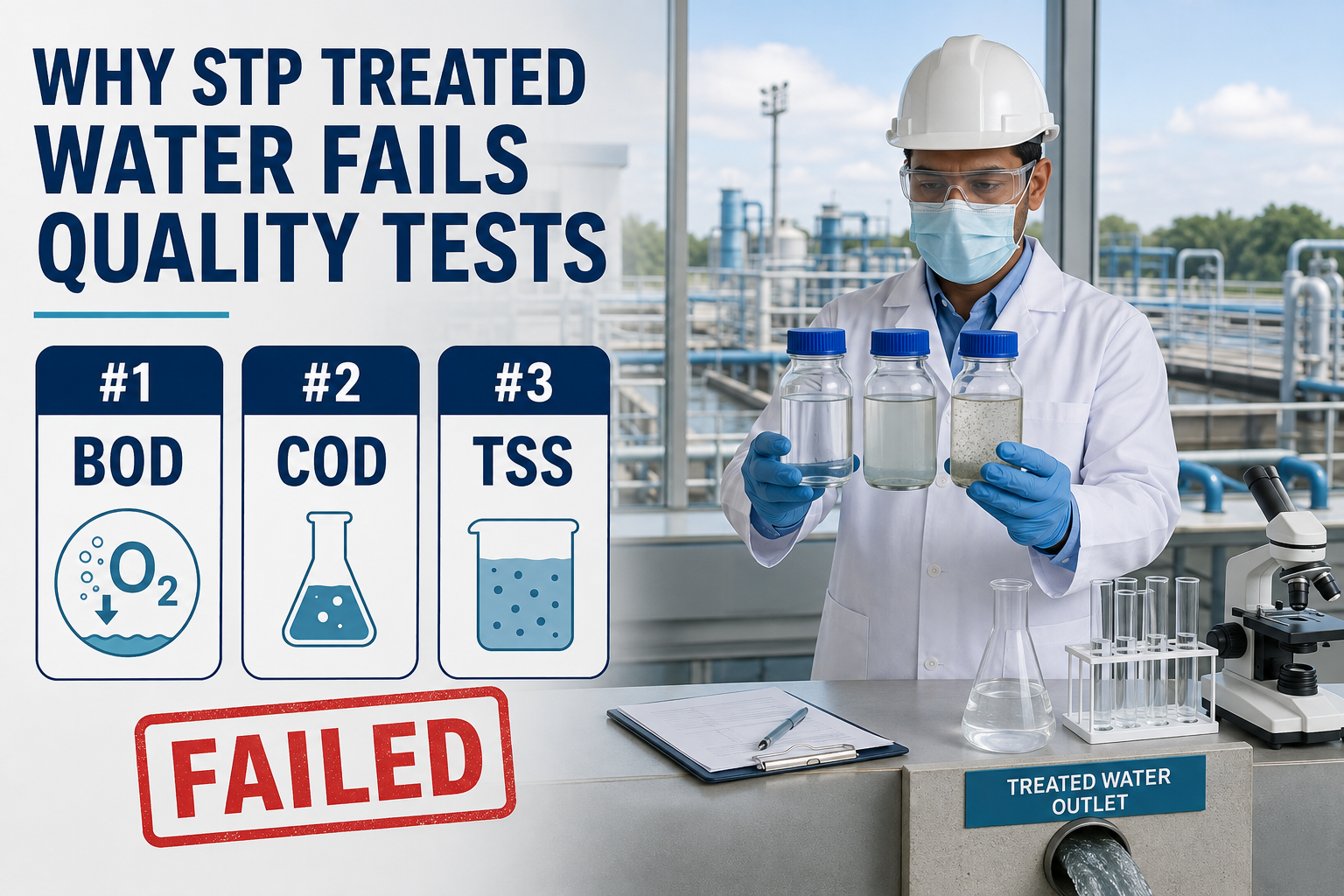
When an STP is operating but its treated water still fails laboratory tests, the problem is usually not limited to one piece of equipment. Poor aeration, excessive sludge, hydraulic overloading, inadequate settling, poor filtration, irregular maintenance and changes in incoming sewage can all affect the final outlet quality. These are common STP treated-water quality problems faced by residential complexes, factories, hotels, hospitals, commercial buildings and large facilities.
BOD, COD and TSS are particularly important because they indicate the amount of biodegradable organic matter, chemically oxidisable pollutants and suspended solids remaining after treatment. For facilities relying on STP Maintenance Services in Bangalore and across India, understanding these parameters helps facility and plant managers identify the actual cause of poor performance rather than simply increasing chemicals or running equipment continuously.
This guide explains why treated water fails quality tests, what each parameter means, how to identify the root cause and what practical corrective actions can improve STP performance.
What Are STP Treated-Water Quality Problems?
STP treated-water quality problems occur when the final treated sewage does not meet the applicable discharge or reuse requirements for parameters such as BOD, COD, TSS, pH, nitrogen and microbiological quality. The reasons may originate in biological treatment, clarification, filtration, disinfection, hydraulics or plant operation.
Common symptoms include:
- BOD remaining higher than the required limit
- COD consistently above the target
- TSS in the final outlet
- Cloudy or turbid treated water
- Excessive sludge carryover
- Unstable pH
- Poor dissolved oxygen levels
- Foaming in aeration tanks
- Unpleasant odour
- Inconsistent laboratory results
The applicable limit depends on the discharge route, consent conditions and intended reuse. For example, CPCB directions applicable to Karnataka STPs specify pH 6.5–9.0, BOD not more than 10 mg/L, COD not more than 50 mg/L and TSS not more than 20 mg/L for the referenced standards.
Why Do STP Treated-Water Quality Problems Occur?
The most common reason is an imbalance between the sewage entering the plant and the treatment conditions inside it.
An STP needs sufficient biological activity, oxygen, retention time, sludge management and clarification to consistently produce good-quality effluent. If any of these are disrupted, the final water quality can deteriorate.
Major causes include:
- Hydraulic overloading
- Organic overloading
- Insufficient aeration
- Poor sludge return or excess sludge
- Inadequate settling
- Damaged or blocked filters
- Poor screening and pretreatment
- Sudden changes in influent characteristics
- Irregular operation and maintenance
- Inaccurate sampling or laboratory procedures
A plant can therefore appear to be “running” while still performing poorly.
What Causes High BOD in STP-Treated Water?
High BOD after treatment generally indicates that biodegradable organic matter has not been sufficiently removed. It can result from inadequate biological treatment, insufficient oxygen, poor microbial activity, excessive loading or short treatment time.
Common causes of high BOD
- Low dissolved oxygen in the aeration tank
- Insufficient aeration
- Blower or diffuser problems
- Excessive organic loading
- Low or unhealthy biomass concentration
- Inadequate sludge return
- Short hydraulic retention time
- Toxic substances entering the biological process
- Sudden variations in sewage flow or composition
For example, if a facility suddenly receives a much higher organic load than its STP was designed to handle, microorganisms may not have enough capacity or contact time to break down the additional organic matter.
How to reduce high BOD
Facility teams should first investigate the biological process rather than immediately adding chemicals.
Check:
- Aeration blower performance
- Diffuser condition
- Dissolved oxygen
- MLSS and sludge condition
- Sludge return rate
- Inlet flow and organic loading
- Aeration tank retention time
- Presence of toxic or inhibitory substances
Persistent high BOD in treated wastewater should be investigated using trend data rather than a single laboratory result.
Why Does COD Remain High After STP Treatment?
COD measures the oxygen required to chemically oxidise organic and other oxidisable substances in wastewater. High COD after treatment can indicate incomplete removal of organic matter, non-biodegradable compounds, or the presence of chemicals that are difficult for biological treatment to degrade.
Common reasons for high COD
- Excess organic loading
- Poor biological treatment
- Inadequate aeration
- Non-biodegradable compounds
- Cleaning chemicals entering the sewage stream
- Industrial wastewater mixing with domestic sewage
- Sludge carryover
- Insufficient treatment or retention time
The relationship between BOD and COD can also provide useful diagnostic information. If both are high, inadequate overall treatment may be the issue. If COD remains high while BOD is relatively low, the wastewater may contain a larger proportion of poorly biodegradable or non-biodegradable substances.
How to control high COD
Start by checking the source of the incoming wastewater.
Look for:
- Cleaning chemicals
- Solvents or process chemicals
- Excessive detergents
- Oil and grease
- Industrial discharge entering a domestic STP
- Sudden changes in wastewater characteristics
If high COD in STP-treated water continues despite stable biological operation, influent characterisation and process-specific investigation may be necessary.
What Causes High TSS in STP Outlet Water?
TSS represents suspended particles remaining in the water. High TSS at the outlet usually points toward poor solids separation, sludge carryover, inadequate clarification, or problems in downstream filtration.
Typical causes include:
- Secondary clarifier overload
- Poor sludge settling
- Excessive sludge blanket
- Improper sludge wasting
- Hydraulic surges
- Damaged filter media
- Inadequate backwashing
- Blocked or poorly maintained filters
- Biological bulking
A useful diagnostic approach is to compare water quality before and after clarification and filtration. If TSS rises sharply after the clarifier, investigate settling and sludge management. If clarification is satisfactory but final TSS increases after filtration, inspect the filter system.
Key STP Water-Testing Parameters to Monitor
Regular testing gives facility managers a clearer picture of plant performance than relying only on the final outlet sample.
Important STP water-testing parameters include:
| Parameter | What it indicates | What a high result may suggest |
| BOD | Biodegradable organic load | Incomplete biological treatment |
| COD | Total chemically oxidisable load | Organic/chemical contamination |
| TSS | Suspended solids | Poor clarification or filtration |
| pH | Acidity/alkalinity | Process imbalance or chemical contamination |
| Ammoniacal nitrogen | Nitrogen removal performance | Weak nitrification |
| Total nitrogen | Overall nitrogen removal | Inadequate nutrient treatment |
| Fecal coliform | Microbiological quality | Inadequate disinfection |
| Oil & grease | Fats and oils | Poor pretreatment or external contamination |
The required parameters and limits should always be checked against the facility’s applicable consent conditions and intended reuse/discharge route.
How to Diagnose Poor STP Outlet-Water Quality
A structured diagnosis is more effective than changing several operating parameters at once.
Step 1: Check the influent
Test incoming sewage and identify unusual changes in BOD, COD, TSS, pH or other relevant parameters.
Step 2: Check flow
Compare actual daily flow with the plant’s design capacity. Hydraulic overloading can reduce effective retention time and cause solids to escape with the treated water.
Step 3: Inspect aeration
Check blower operation, air distribution, diffuser condition and dissolved oxygen. Poor oxygen transfer can directly affect biological treatment.
Step 4: Inspect sludge
Check sludge blanket, settling behaviour, MLSS and sludge wasting practices where applicable.
Step 5: Check clarification
Look for floating sludge, cloudy overflow, short-circuiting and excessive solids carryover.
Step 6: Check tertiary treatment
Inspect pressure sand filters, activated carbon filters, membranes or other polishing systems installed at the facility.
Step 7: Verify disinfection
If treated water is reused for applications requiring microbiological control, verify the disinfection system and contact conditions.
Step 8: Confirm the test result
Use proper sampling procedures and an appropriate laboratory. A single abnormal sample should be investigated before making major process changes.
Common STP Operation Mistakes That Affect Water Quality
Some STP treated-water quality problems are caused by operational practices rather than plant design.
Common mistakes include:
- Operating the plant intermittently
- Switching blowers off for excessive periods
- Ignoring diffuser clogging
- Allowing sludge to accumulate
- Delaying filter backwashing
- Failing to record flow and operating parameters
- Overdosing disinfectants without understanding the process
- Mixing industrial wastewater with domestic sewage without assessment
- Skipping routine laboratory testing
- Treating symptoms instead of identifying the root cause
A preventive maintenance schedule should cover pumps, blowers, diffusers, clarifiers, filters, dosing systems, sensors and electrical equipment.
How Facility Managers Can Prevent Quality-Test Failures
Preventive monitoring is usually more effective than reacting after a sample fails.
A practical monitoring programme should include:
- Daily operational checks: flow, equipment status, odour, colour and visible solids.
- Process monitoring: dissolved oxygen, sludge condition and relevant biological indicators.
- Routine laboratory testing: BOD, COD, TSS, pH and other parameters applicable to the site.
- Equipment maintenance: blowers, pumps, diffusers, filters and dosing systems.
- Sludge management: regular inspection, wasting and safe handling.
- Trend analysis: compare results over weeks and months instead of looking at isolated values.
- Source control: identify chemicals, oils or unusual wastewater entering the STP.
For Bangalore facilities, this is particularly relevant because KSPCB-related STP conditions can specify stringent outlet requirements. Karnataka records also demonstrate that an STP can meet some parameters while failing others, highlighting the importance of monitoring each parameter independently.
Should You Upgrade the STP If BOD, COD or TSS Remains High?
Not necessarily. An equipment upgrade should normally follow a root-cause assessment.
Before considering additional treatment capacity, evaluate:
- Actual sewage flow
- Influent characteristics
- Existing plant capacity
- Biological loading
- Aeration performance
- Sludge management
- Clarifier performance
- Filtration efficiency
- Equipment condition
- Applicable outlet standards
If the existing STP is fundamentally undersized, poorly configured or unable to achieve the required treatment quality despite proper operation, modification or additional treatment may be justified.
When Should You Get Professional STP Maintenance Support?
Professional assessment is useful when test results remain inconsistent despite routine operation and maintenance.
It is especially worth considering when:
- BOD or COD repeatedly exceeds the applicable limit
- TSS suddenly increases
- The plant develops persistent odour
- Sludge settles poorly
- Equipment frequently fails
- Treated water quality varies significantly
- The facility has recently increased occupancy or production
- Industrial or chemical wastewater has entered the system
- The plant is approaching or exceeding its design capacity
A professional STP service team can assess the treatment process, equipment condition, operating practices and laboratory trends before recommending corrective measures.
Conclusion
Consistently good treated-water quality depends on more than simply keeping an STP switched on. STP treated-water quality problems can originate from excessive loading, inadequate aeration, poor sludge management, clarification failures, filtration issues or changes in incoming wastewater.
BOD, COD and TSS should be evaluated together with flow, process conditions and other applicable parameters. Facilities in Bangalore and across India should also verify the standards applicable to their specific discharge or reuse arrangement.
For businesses, factories, commercial buildings, residential communities and institutional facilities, regular monitoring and preventive STP maintenance can identify deterioration before it becomes a repeated compliance problem. PRKGlobal360 can support facilities with systematic STP operation, maintenance and performance monitoring based on site-specific requirements.
Need Reliable STP Maintenance and Water Quality Monitoring?
Persistent BOD, COD, or TSS issues can indicate underlying problems with aeration, sludge management, filtration, or plant operation. PRKGlobal360 provides professional STP operation and maintenance services to help facilities maintain consistent treated-water quality and improve plant performance. Contact our team to discuss your STP requirements and schedule a site assessment.
Call or WhatsApp: +91 96061 71055
Email: prkmanagement.blr@gmail.com
Frequently Asked Questions
Why does STP-treated water fail laboratory tests?
Treated water can fail because of poor aeration, excessive hydraulic or organic loading, inadequate settling, sludge carryover, filtration problems, equipment failure or unusual contaminants entering the plant. The first step should be to identify which parameter failed and compare it with process and influent data.
What is the acceptable BOD level for STP-treated water?
The applicable BOD limit depends on the relevant regulatory requirement, consent condition and discharge or reuse application. CPCB directions referenced for Karnataka specify BOD of not more than 10 mg/L for the cited STP discharge standards. Facilities should verify their current site-specific consent conditions before using a limit for compliance decisions.
What causes TSS to increase in treated sewage?
High TSS commonly results from poor sludge settling, excessive sludge blanket, hydraulic overloading, biological bulking, clarifier problems or ineffective filtration. Comparing TSS at different treatment stages can help determine whether the problem originates in clarification or tertiary filtration.
Can high COD occur even when BOD is low?
Yes. COD includes chemically oxidisable substances that may not be readily biodegradable. Therefore, COD can remain relatively high even when biological treatment has reduced BOD effectively. Persistent differences between BOD and COD should prompt investigation of non-biodegradable compounds or chemical contamination.
How often should STP treated water be tested?
Testing frequency should follow applicable regulatory requirements, consent conditions, reuse requirements and the facility’s operational risk. In addition to laboratory testing, operators should perform routine process checks and maintain records of flow, equipment operation and key treatment parameters.
Does increasing aeration always solve high BOD?
No. Increasing aeration may help when insufficient oxygen is the limiting factor, but it will not solve every BOD problem. Excess loading, toxic substances, inadequate biomass, poor sludge management, short retention time or hydraulic problems may require different corrective actions.
When should an STP be upgraded instead of repaired?
An upgrade may be appropriate when the plant is consistently overloaded, fundamentally undersized, improperly configured or unable to meet applicable requirements despite proper operation and maintenance. A technical assessment should be completed before investing in additional treatment equipment.
 Chat on WhatsApp