

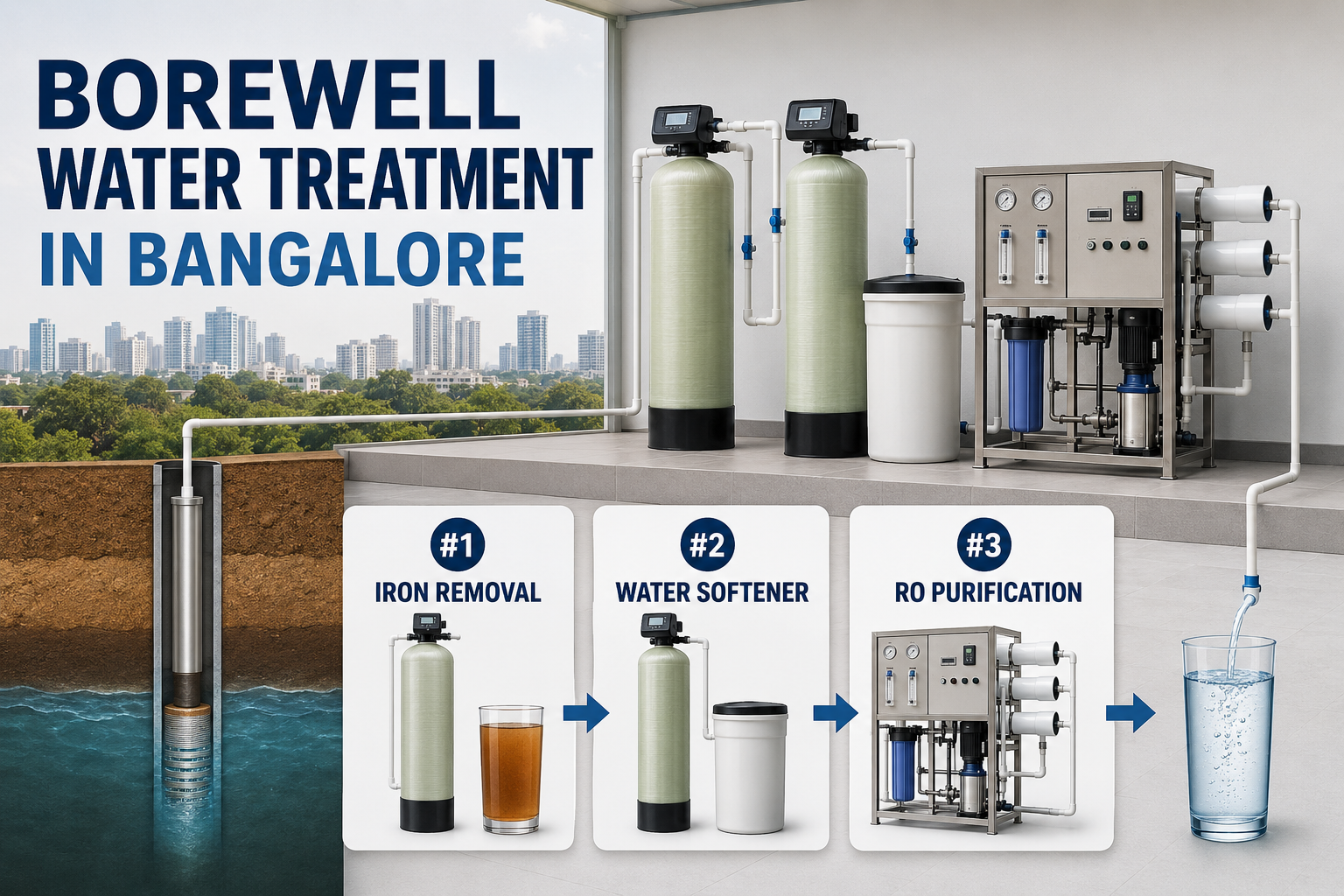
Borewell water is widely used for residential buildings, apartments, commercial properties, industries and institutional facilities in Bangalore. However, groundwater quality can vary significantly from one location to another. High TDS, hardness, iron, turbidity and other dissolved or suspended contaminants can affect water usability, equipment performance and treatment requirements.
Borewell water treatment in Bangalore should therefore begin with laboratory testing rather than selecting a standard filtration plant. The treatment process depends on the actual water analysis, intended use and required output quality. Professional Water Treatment Plant Services in Bangalore can help assess these parameters, recommend suitable treatment technologies and design a system based on site-specific requirements. This guide explains how TDS, hardness and iron are treated, what a typical treatment system includes, and what facility owners should consider before installation.
Call or WhatsApp: +91 96061 71055
What Is Borewell Water Treatment?
Borewell water treatment is the process of removing or reducing unwanted physical, chemical and biological contaminants from groundwater so that the treated water is suitable for its intended application.
A treatment system may include different technologies depending on the raw-water characteristics, such as:
- Raw-water storage and pumping
- Pressure sand filtration
- Activated carbon filtration
- Iron and manganese removal
- Water softening
- Micron filtration
- Reverse osmosis (RO)
- Disinfection
- Treated-water storage
The objective is not necessarily to remove every dissolved mineral. Instead, the system should be designed around the contaminants identified through water testing and the quality required at the point of use.
Why Does Borewell Water Need Treatment in Bangalore?
Groundwater can contain elevated concentrations of dissolved minerals picked up as water moves through geological formations. Depending on the borewell location and depth, users may notice scaling, metallic taste, staining, unpleasant odour or changes in water appearance.
For drinking-water applications, IS 10500:2012 specifies requirements and test methods for drinking water, including parameters such as TDS, total hardness and iron. BIS also distinguishes between acceptable limits and permissible limits when an alternate source is unavailable.
This makes water testing an essential first step. A treatment plant selected without knowing the raw-water chemistry may be ineffective, unnecessarily expensive or difficult to maintain.
TDS, Hardness and Iron: What Is the Difference?
These three parameters are often discussed together, but they describe different aspects of water quality.
| Parameter | What it indicates | Typical treatment approach |
| TDS | Total dissolved substances in water | RO or other suitable desalination process |
| Hardness | Mainly calcium and magnesium salts | Water softener or membrane treatment |
| Iron | Dissolved or particulate iron | Oxidation, filtration or dedicated iron removal |
For drinking water, BIS’s IS 10500 framework includes testing for TDS, total hardness and iron among its specified parameters.
A key point is that high TDS does not automatically mean that RO is required for every application. If the water is intended for flushing, gardening, cooling or other non-potable uses, the appropriate treatment may be different.
How Does Borewell Water Treatment in Bangalore Work?
A properly designed treatment system generally follows a sequence based on the raw-water test report.
1. Raw Water Testing
The first step is to collect a representative borewell sample and test relevant parameters. Depending on the intended application, testing may include:
- pH
- TDS
- Total hardness
- Iron
- Manganese
- Turbidity
- Chloride
- Sulphate
- Alkalinity
- Fluoride
- Nitrate
- Microbiological parameters
Additional testing may be required where site conditions or the intended application indicate a need.
2. Pre-Treatment
Suspended particles and turbidity can interfere with downstream treatment equipment. Pressure sand filters are commonly used to reduce suspended solids and turbidity before subsequent stages.
Activated carbon may be considered where taste, odour or certain organic contaminants are a concern.
3. Iron Removal
Iron can cause reddish-brown staining, metallic taste and deposits in plumbing and fixtures. Depending on its concentration and chemical form, treatment may involve aeration or oxidation followed by filtration.
An iron removal plant for borewell water should be selected only after understanding the iron concentration and whether the iron is dissolved, particulate or associated with other contaminants.
4. Hardness Reduction
Hard water contains elevated calcium and magnesium. It can cause scale formation inside pipes, heaters, boilers, cooling systems and other equipment.
A water softener exchanges hardness-causing ions with sodium ions. However, softening primarily addresses hardness; it does not function as a complete solution for high TDS.
5. High-TDS Treatment
When dissolved solids are substantially higher than the required water-quality target, membrane treatment such as RO may be appropriate.
A high TDS borewell water treatment system should be designed around feed-water TDS, flow rate, recovery requirement, pressure, temperature and the desired treated-water quality.
6. Disinfection and Storage
Where treated water is intended for potable use, microbiological safety must also be considered. Depending on the system design, disinfection may use methods such as chlorination or ultraviolet treatment.
The treated water should then be stored in a properly maintained tank before distribution.
How to Choose a Borewell Water Purification System
Choosing a borewell water purification system should be based on data rather than a one-size-fits-all package.
Consider these factors:
- Raw-water quality: Obtain a current laboratory test report.
- Water requirement: Calculate daily consumption and peak flow.
- End use: Drinking, domestic use, process water, cooling or other applications may require different treatment.
- Contaminant levels: Identify which parameters actually need correction.
- Required treated-water quality: Define the quality target before selecting equipment.
- Space availability: Consider equipment footprint, piping and chemical/storage requirements.
- Power and operating requirements: Pumps, RO systems and automation can affect energy consumption.
- Reject-water management: RO installations require a suitable plan for concentrate/reject water.
- Maintenance: Filters, membranes, valves, dosing systems and instrumentation need periodic servicing.
- Future capacity: Allow for changes in occupancy, production or water demand where appropriate.
Common Problems Caused by Untreated Borewell Water
Untreated groundwater can create operational problems beyond taste and appearance.
Common issues include:
- Scale formation in pipelines and heating equipment
- Brown or reddish stains caused by iron
- Clogging of fixtures and filters
- Reduced efficiency of heat-transfer equipment
- Unpleasant taste or odour
- Membrane fouling
- Higher maintenance requirements
- Inconsistent water quality
For buildings and commercial facilities, these problems can increase maintenance frequency and affect the performance of water-dependent equipment.
Borewell Water Treatment Plant Cost: What Determines It?
There is no reliable single price for a treatment plant because system requirements differ from site to site.
The overall cost can depend on:
- Raw-water quality
- Required treatment capacity
- Number and type of treatment stages
- RO capacity and recovery
- Automation level
- Pumping requirements
- Civil and electrical work
- Storage capacity
- Installation conditions
- Consumables and maintenance requirements
A lower initial equipment price may not necessarily mean a lower total cost of ownership. Energy consumption, membrane replacement, filter media, chemicals, spare parts and routine servicing should also be considered.
Best Practices for Borewell Water Treatment
For reliable long-term operation, facility managers should:
- Test borewell water periodically.
- Monitor changes in TDS, hardness and iron.
- Keep filter and membrane maintenance records.
- Follow recommended backwashing and regeneration schedules.
- Avoid operating equipment outside its design flow.
- Check pumps, valves, pressure gauges and dosing systems regularly.
- Clean storage tanks at appropriate intervals.
- Test treated water against the quality requirement of its intended use.
For drinking-water applications, treatment should be validated against applicable water-quality requirements rather than relying only on visual appearance or TDS readings. BIS’s IS 10500 standard covers a broader range of physical, chemical and microbiological requirements.
When Should You Contact a Water Treatment Professional?
Professional assessment is particularly useful when a borewell has:
- Very high TDS
- Persistent hardness or scaling
- Visible iron staining
- Unusual taste or odour
- Rapid filter or membrane fouling
- Changing water quality
- High daily water demand
- Multiple end-use requirements
A qualified treatment provider can evaluate the water report, calculate the required capacity and recommend a process flow rather than simply supplying an off-the-shelf filter.
For businesses and facilities in Bangalore, Prkglobal360 can help assess water-treatment requirements and develop an appropriate approach based on site conditions and water-quality objectives.
Conclusion
Effective borewell water treatment in Bangalore starts with understanding the water rather than choosing equipment based only on TDS or hardness. High TDS, hardness and iron require different treatment approaches, and a complete solution may combine filtration, iron removal, softening, RO and disinfection depending on the application.
For commercial buildings, industries and managed facilities, proper design and preventive maintenance can help maintain consistent water quality while protecting plumbing and water-dependent equipment. If you need help evaluating your borewell water or planning a suitable treatment system, contact Prkglobal360 for a site-specific assessment and treatment solution.
Need Professional Borewell Water Treatment in Bangalore?
Choosing the right treatment process can help manage TDS, hardness, iron and other borewell-water quality concerns effectively. For expert guidance, site assessment, treatment plant requirements or facility-specific solutions, connect with Prkglobal360 today.
Call or WhatsApp: +91 96061 71055
Email: prkmanagement.blr@gmail.com
Frequently Asked Questions
Is borewell water safe for drinking?
Borewell water should not be assumed to be safe for drinking simply because it looks clear. Groundwater can contain dissolved minerals, metals, chemicals or microorganisms that are not visible. A laboratory water-quality test should be carried out, followed by treatment appropriate to the identified contaminants and the applicable drinking-water requirements.
How can high TDS in borewell water be reduced?
High TDS can often be reduced using membrane-based treatment such as reverse osmosis, but the appropriate solution depends on the actual TDS and other water parameters. RO is not automatically necessary for every borewell application. Testing and end-use requirements should determine the treatment method.
Does a water softener reduce TDS?
Generally, no. A conventional ion-exchange softener primarily reduces calcium and magnesium hardness. It does not provide the same dissolved-solids reduction as RO. If both hardness and high TDS are present, a treatment system may require separate or combined processes.
How is iron removed from borewell water?
Iron removal depends on the concentration and form of iron present. Common approaches include oxidation or aeration followed by filtration, while some applications may require specialized media or additional treatment. A water analysis helps determine the appropriate process and equipment configuration.
How often should borewell water be tested?
Testing frequency depends on the application, water-source conditions and local operating requirements. Facilities should establish a monitoring schedule based on their risk profile and treatment system. Additional testing is advisable when water quality changes, a new borewell is commissioned or treatment performance declines.
Is RO suitable for all borewell water?
No. RO is designed primarily to reduce dissolved substances and may not be the best first-stage treatment for every borewell. High turbidity, iron, hardness or other contaminants may require pre-treatment to protect the membrane and improve performance.
What is the first step before installing a treatment plant?
The first step is a representative raw-water laboratory analysis. The report provides the information needed to determine treatment stages, plant capacity and operating requirements. Installing equipment before understanding the water chemistry can lead to poor treatment performance and unnecessary operating costs.
 Chat on WhatsApp