

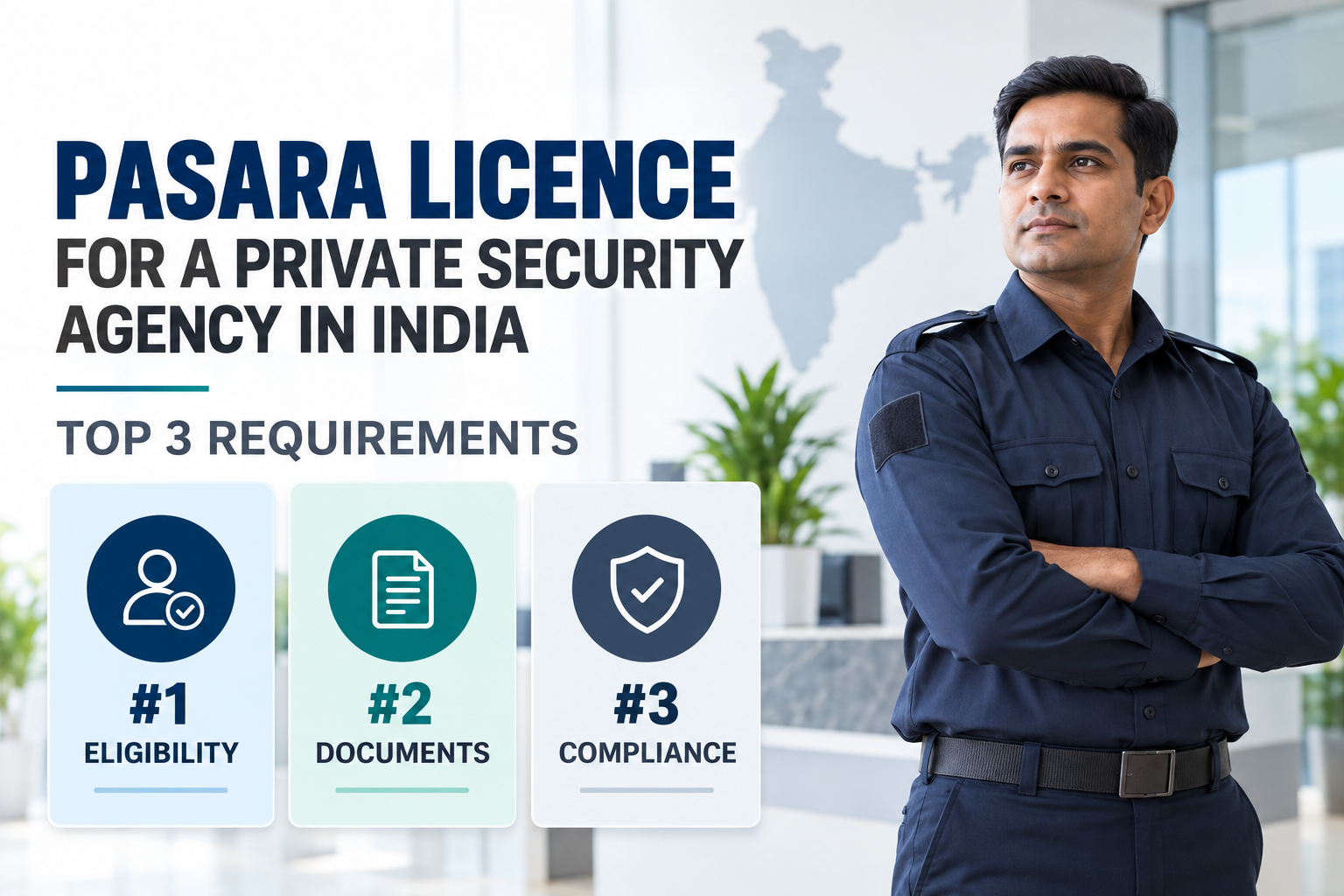
Starting a private security business in India requires more than registering an entity and preparing operations. Businesses that want to start a private security agency in India must understand the regulatory framework under the Private Security Agencies (Regulation) Act, 2005 (PSARA) and follow the licensing requirements set by the relevant Controlling Authority.
A PSARA licence allows eligible private security agencies to provide regulated security services after meeting statutory requirements. Before you start a private security agency in India, it is important to review eligibility conditions, prepare supporting records, and understand the filing requirements applicable to the state or Union territory where the agency will operate.
Call or WhatsApp: +91 96061 71055
Understanding the PSARA Licence Requirement
The term PASARA licence is commonly used in online searches, although the governing legislation refers to PSARA under the Private Security Agencies (Regulation) Act, 2005. The licensing authority and application procedures may differ depending on the jurisdiction.
Entrepreneurs often search for How to get PASARA licence for a security agency, but the correct approach is to identify the relevant Controlling Authority, obtain the latest requirements and prepare an accurate application file.
A licence is generally required before conducting regulated private security agency activities. The approval process is not simply a registration step; authorities examine eligibility, documentation and compliance-related information before granting permission.
Eligibility Requirements Before Applying
The decision to Start a private security agency in India should begin with an eligibility review. The law contains conditions related to applicants, ownership, management, antecedents, citizenship and certain disqualifications.
Applicants should verify:
- Ownership and management details are accurate.
- Required identity and address records are available.
- Statutory declarations are complete and truthful.
- There are no disqualifying circumstances under the applicable law.
- Operational requirements can be fulfilled after approval.
Understanding these requirements early helps reduce avoidable delays during scrutiny.
Documents Generally Required
When you Start a private security agency in India, your application should be supported by properly organised records. The exact checklist depends on the jurisdiction, but commonly requested documents may include:
- Business incorporation or registration documents.
- Constitutional documents of the entity.
- Identity and address proof of applicants and responsible persons.
- Photographs and prescribed declarations.
- Proof related to the business premises.
- Affidavits, undertakings or statutory forms required by the authority.
- Additional documents requested under state-specific procedures.
Applicants should match each document with the requirement it supports and avoid submitting inconsistent information across different records.
Step-by-Step Application Process
1. Confirm the Applicable Authority
The first step is identifying the correct Controlling Authority for the proposed area of operation. Different states and Union territories may follow different filing systems, forms and supporting document requirements.
2. Prepare the Application File
Applicants planning to Start a private security agency in India should create a complete record containing the application form, supporting documents, declarations and payment details where applicable.
Check that names, addresses, entity information and management details match across all documents. Small inconsistencies can lead to clarification requests or delays.
3. Submit Through the Approved Channel
The filing method depends on the jurisdiction. Some authorities provide online systems, while others may require additional physical submissions or verification-related steps.
Businesses researching how to get private security agency license should rely on current authority instructions rather than outdated online checklists.
4. Complete Verification and Scrutiny
After submission, the authority may review documents, conduct required verification and seek additional clarification. Responding accurately and maintaining copies of all communication helps keep the process organised.
5. Follow Post-Approval Requirements
Approval is only the beginning of compliance. Agencies must follow licence conditions, maintain required records and meet applicable operational obligations.
Online Filing and Compliance Considerations
A digital application facility may be available in certain jurisdictions, but the complete procedure is not necessarily identical across India. Applicants should confirm whether verification, document submission or follow-up communication requires additional steps.
People researching how to apply for private security agency license should understand that online submission does not remove the need for compliance review or authority verification.
Common Reasons Applications Face Delays
Applications may be delayed due to:
- Incomplete forms.
- Missing declarations.
- Incorrect document formats.
- Mismatched names or addresses.
- Unsupported statements.
- Failure to follow jurisdiction-specific instructions.
Applicants should avoid using generic checklists without confirming whether they apply to the intended operating area.
Practical Preparation Tips
If you Start a private security agency in India, maintain a structured application file from the beginning. Useful preparation steps include:
- Confirm the latest requirements from the competent authority.
- Organise documents into clearly labelled sections.
- Review declarations before signing.
- Keep copies of every submitted document.
- Track responses, acknowledgements and authority communication.
- Assign responsibility for ongoing compliance management.
Professional guidance can help businesses understand documentation gaps and procedural requirements. Organisations seeking Complete support to obtain PASARA licence should ensure that any assistance provider understands the applicable legal framework and jurisdictional requirements.
Choosing the Right Compliance Approach
A business that wants to Start a private security agency in India should treat licensing as a compliance project rather than a one-time form submission. A properly prepared application reduces confusion and creates a stronger foundation for future operations.
The licence application process involves multiple stages, including eligibility review, document preparation, submission, scrutiny and post-approval compliance. Agencies should maintain accurate records and update their procedures whenever regulatory requirements change.
For businesses planning expansion, understanding PASARA licence for private security company requirements can help avoid operational disruptions and support long-term compliance.
Conclusion
Obtaining a PSARA licence requires careful preparation, accurate documentation and awareness of jurisdiction-specific procedures. Those who start a private security agency in India should verify current requirements, prepare a complete evidence file, consider facility management services as part of their service offerings, and maintain compliance after approval.
A successful application depends on consistency, transparency and proper record management. By approaching the process systematically, entrepreneurs can build a stronger foundation for operating a compliant private security agency in India.
Get Professional Support for Your Security Agency
Planning to start a private security agency or expand into facility management services? Get professional guidance for PSARA licence requirements, documentation and compliance. Contact the team to discuss your requirements and take the next step towards establishing your security services business.
Call or WhatsApp: +91 96061 71055
Email: prkmanagement.blr@gmail.com
Frequently Asked Questions
Can every entrepreneur apply for a PSARA licence?
No. Applicants must meet eligibility requirements under the applicable law and rules. Authorities may consider factors related to ownership, management, antecedents and other statutory conditions.
Is the licence process the same in every state?
No. While PSARA provides the national framework, administrative procedures, forms and supporting requirements may differ between jurisdictions.
How long does the approval process take?
The timeline depends on the completeness of the application, verification requirements and the workload of the relevant authority. Applicants should rely on current official procedures instead of general estimates.
Is online filing available everywhere?
Not necessarily. Some jurisdictions provide online facilities, while others may require additional verification or document-related steps.
What should applicants do after receiving approval?
Agencies should maintain required records, follow licence conditions and ensure ongoing compliance with applicable rules and authority requirements.
 Chat on WhatsApp