

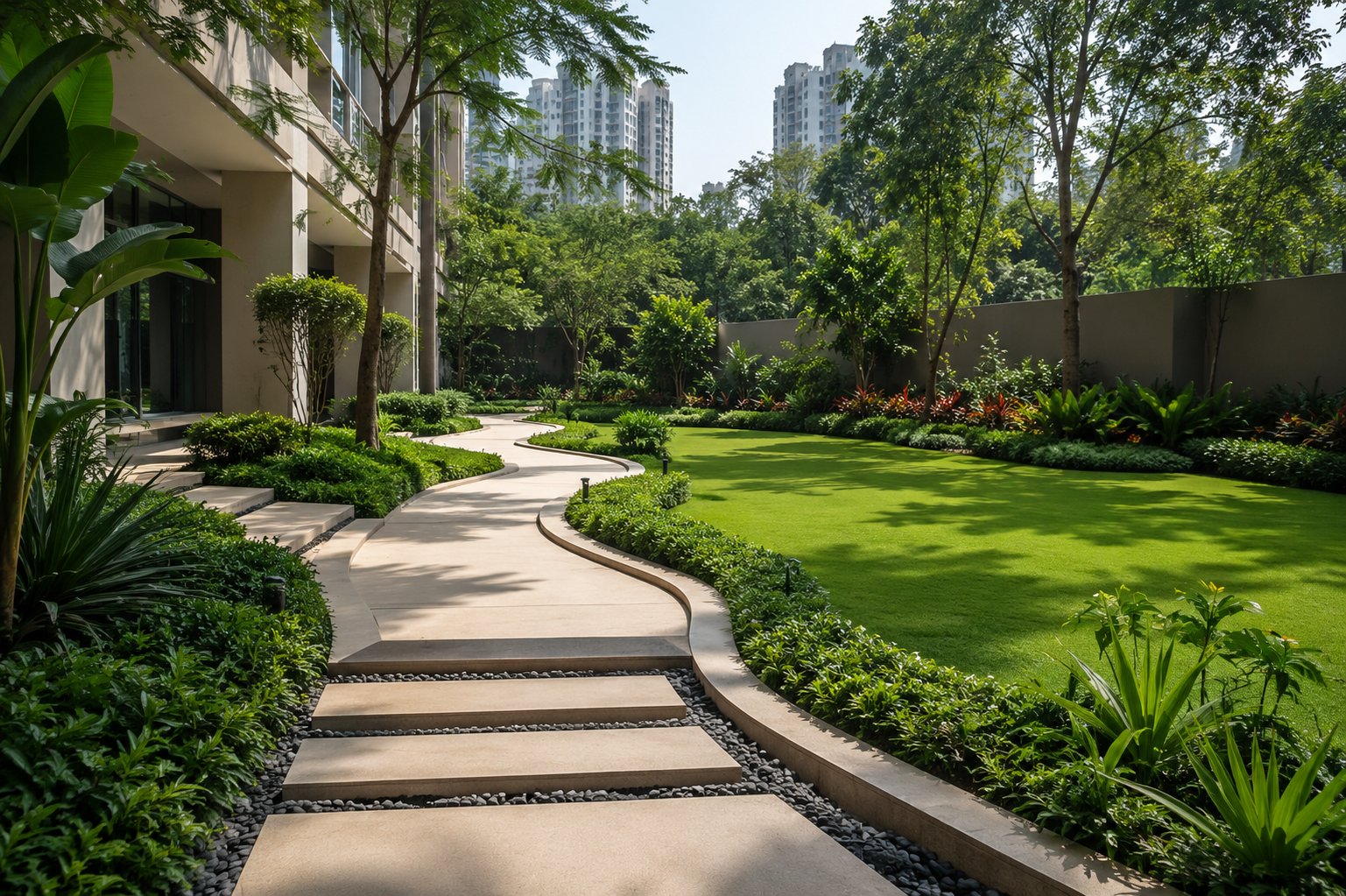
Creating an attractive landscape involves much more than selecting plants and installing a lawn.
A successful outdoor environment needs to respond to the property, movement patterns, available sunlight, water management, soil conditions, maintenance requirements and the way people will actually use the space.
These considerations become particularly important for apartment communities, villas, corporate campuses, commercial properties, institutions and hospitality environments where landscaping must continue to perform long after project handover.
Professional landscape development services in Bangalore bring planning, horticulture, irrigation, hardscape execution and maintenance considerations into one coordinated project.
This guide explains how a landscape-development project should move from initial site assessment through design, execution, planting and ongoing maintenance.
Call or WhatsApp: +91 96061 71055
What Is Landscape Development?
Landscape development is the process of planning and physically developing an outdoor space so that its built and planted elements work together.
It can include landscape planning, ground preparation, soil improvement, grading, drainage coordination, irrigation, pathways, seating areas, planting, lawns and other outdoor elements depending on the property.
Landscape design and landscape development are related but not identical.
Design focuses on how the proposed outdoor space should be organized and experienced.
Development is the stage where those plans are converted into an actual landscape.
A complete project therefore needs to consider both appearance and long-term operation.
Begin With the Site, Not the Plant Catalogue
One of the most important stages of landscape development happens before plants are selected.
The property should first be assessed.
The landscape team needs to understand sunlight and shade, ground levels, drainage paths, soil condition, existing vegetation, available water, utility locations, pedestrian movement and access for future maintenance.
These conditions influence later decisions.
For example, a heavily shaded zone may need a different planting approach from an exposed entrance.
A low-lying area may need drainage attention before planting begins.
A large tree requires consideration of mature canopy and root space rather than only its appearance when installed.
Landscape planning becomes more reliable when the design responds to actual site conditions.
Define How the Outdoor Space Will Be Used
Landscape design should also respond to the purpose of the property.
An apartment community may require entrance landscaping, walking paths, children’s areas, senior-friendly seating, clubhouse surroundings and recreational green space.
A corporate property may need an attractive arrival area, pedestrian circulation, outdoor breakout spaces, shaded seating and low-maintenance planted zones.
A villa may prioritize privacy, family recreation and a more personalized garden.
A hotel or hospitality property may focus heavily on arrival experience, guest movement and outdoor gathering areas.
There is no single landscape layout that works for every property.
The site should be divided according to actual functional requirements before decorative elements are selected.
Develop a Landscape Concept
Once the property requirements and site conditions are understood, a concept plan can be developed.
The concept identifies the major zones of the landscape.
These can include lawns, planting beds, pathways, seating, entrance features, utility screening, activity spaces and other elements.
At this stage, the goal is to determine relationships between spaces.
Where will people walk?
Which zones need shade?
Where should visually important planting be located?
Which areas will require frequent maintenance?
Where will water drain?
A strong concept answers these practical questions before detailed execution begins.
PRKGlobal360 provides landscape design and development services for properties requiring coordinated planning and execution.
Hardscape and Softscape Should Work Together
Landscape development generally combines two broad categories: hardscape and softscape.
Hardscape refers to constructed outdoor elements such as pathways, paving, kerbs, seating areas, planters, decks, pergolas and retaining structures.
Softscape refers to living landscape elements including trees, shrubs, lawns, hedges, groundcovers and flowering plants.
These two parts should not be designed independently.
The width and position of a pathway affect planting space.
Tree pits need adequate space before paving is completed.
Irrigation lines may need to pass below or around hardscape.
Drainage levels need to work across both paved and planted areas.
Coordinating these components during planning can help reduce later adjustments and rework.
Soil Preparation Is a Critical Stage
Plant health depends heavily on what happens below the visible landscape.
Before plantation begins, soil conditions should be assessed and prepared according to the requirements of the proposed planting.
Compaction, drainage problems, construction debris and unsuitable soil conditions can all affect plant establishment.
Ground preparation may include clearing, grading, soil improvement and preparing planting pits or beds.
The correct approach depends on the existing site and the type of landscape being developed.
Planting expensive material into poorly prepared ground is rarely an effective long-term strategy.
Drainage Must Be Planned Before Planting
Water management is one of the most important technical parts of landscape development.
Landscape levels should allow water to move away from areas where prolonged accumulation could create problems.
Pathways, lawns, planting beds and other spaces may need different drainage considerations.
Drainage should also be coordinated with the surrounding building and civil infrastructure.
Trying to correct major level or drainage issues after hardscape and planting are already complete can lead to unnecessary rework.
This is why drainage should be addressed early in the development process.
Plan Irrigation According to Planting Zones
Different landscape areas can have different watering requirements.
Trees, shrubs, lawns and other planting types may not require the same irrigation approach.
An irrigation plan can divide the property into appropriate watering zones and determine how water will be delivered.
Depending on the project, this may involve drip irrigation, sprinklers, valves, controllers or other systems.
The objective should be consistent and practical water management.
The irrigation system should also be accessible for routine inspection and maintenance after handover.
Select Plants for the Site and Maintenance Plan
Plant selection should not be based only on appearance.
Important considerations include available sunlight, soil conditions, available planting space, mature plant size, water requirements and future maintenance.
The maintenance capability of the property matters as well.
A landscape with intensive planting and complex maintenance requirements may not be suitable for a property with limited horticulture resources.
Plant selection should therefore balance aesthetics, site suitability and long-term manageability.
The best planting plan is one that continues to perform as the landscape matures.
Think About Mature Size
A landscape looks very different several years after installation.
Trees expand.
Shrubs become denser.
Roots occupy more space.
Canopies begin to interact with buildings, pathways and other vegetation.
Plant spacing should therefore consider mature size rather than only the appearance required on handover day.
Overplanting can create an impressive immediate result, but it may produce overcrowding and higher pruning requirements later.
A more thoughtful planting strategy gives each major plant enough room to develop appropriately.
Landscape Development for Apartment Communities
Apartment landscaping needs to balance visual appeal with intensive everyday use.
Entrance zones may need strong visual identity.
Common gardens should support resident movement and recreation.
Children’s activity areas require practical circulation and visibility.
Senior residents may benefit from accessible pathways and shaded seating.
Service teams also need access to irrigation systems, planting beds and other maintained areas.
When landscaping is planned only as decoration, these operational requirements can be overlooked.
Residential landscapes work better when functionality and maintenance are considered alongside appearance.
Commercial Landscape Development
Commercial properties often use landscaping to improve arrival experience and the overall character of the site.
Corporate campuses, office complexes, retail environments and hospitality properties can require entrance landscaping, pedestrian routes, outdoor seating, buffer planting and other green areas.
Commercial landscape planning should also consider visitor movement, visibility, operational access and maintenance requirements.
High-visibility areas may receive a different design treatment from large low-traffic zones.
This allows the landscape budget and maintenance effort to be allocated where they provide the greatest value to the property.
Sustainable Landscape Planning
Sustainability in landscape development should be treated as a practical design consideration rather than only a marketing term.
Water use, plant suitability, soil management and maintenance requirements all affect the long-term resources required by a landscape.
Where suitable for the property, irrigation zoning, appropriate plant selection, soil improvement and efficient maintenance planning can contribute to a more manageable landscape.
Rainwater-management strategies can also be considered during site planning where they fit the property’s broader water-management design.
Sustainability works best when it is integrated into the initial landscape concept instead of being added as a separate feature at the end.
Typical Landscape Development Stages
Although every project is different, a professionally managed landscape development normally moves through several stages.
First comes site inspection and requirement gathering.
The team studies the property and understands how the outdoor areas need to function.
Concept planning follows, establishing the overall layout and relationship between hardscape, planting and activity areas.
Detailed planning then addresses plant specifications, materials, irrigation, levels and execution requirements.
Site preparation is completed before or alongside infrastructure work.
Hardscape, irrigation and other relevant elements are coordinated according to the construction sequence.
Plantation and finishing work follow.
The project should then move through inspection, rectification, handover and an appropriate establishment-maintenance process.
Skipping coordination between these stages can create avoidable execution problems.
What Should Be Checked During Landscape Handover?
Landscape handover should involve more than confirming that the property looks attractive.
The completed work should be reviewed against the agreed scope.
Depending on the project, the review can include planting specifications, irrigation operation, drainage, hardscape condition, finishing quality and outstanding rectification items.
Maintenance responsibilities should also be clear.
The property team should know who is responsible for watering, pruning, fertilization, plant replacement, irrigation adjustments and routine inspections after handover.
A landscape-development project should finish with an operational plan rather than simply a completed installation.
The Establishment Period Matters
Newly planted landscapes need time to establish.
During this period, watering, plant-health observation, pruning and replacement of unsuccessful material may require closer attention than they will later.
The exact establishment and maintenance responsibility should be clearly defined in the landscape contract.
This is particularly important for larger projects where the landscape includes significant planting across multiple areas.
A structured transition from project execution to routine maintenance can help preserve the intended design.
For long-term horticulture support, see PRKGlobal360’s garden maintenance services in Bangalore.
Redeveloping an Existing Landscape
Landscape development is not limited to new properties.
Existing apartment communities, offices, campuses and commercial properties may have outdoor areas that no longer perform well.
Common problems can include overgrown vegetation, damaged pathways, irrigation issues, unsuitable planting, poor utilization of open space or maintenance-heavy layouts.
Redevelopment does not always require removing everything.
Healthy trees and useful landscape elements can be retained while weak areas are redesigned.
This approach can modernize the property while preserving established vegetation and previous investment where appropriate.
Common Landscape Development Mistakes
Several avoidable mistakes can affect long-term landscape performance.
Selecting plants before assessing sunlight and soil conditions is one.
Ignoring drainage until after the landscape is installed is another.
Overplanting for an immediate dense appearance can create maintenance challenges later.
Installing hardscape without coordinating irrigation and tree locations can lead to rework.
Another common problem is creating a highly complex landscape without considering who will maintain it.
Good landscape development avoids these problems by making operational decisions during planning rather than after completion.
How Is Landscape Development Cost Calculated?
Landscape development does not have one meaningful fixed rate for every property.
The project cost depends on the actual scope.
Important factors can include site area, existing ground condition, soil preparation, plant quantities and sizes, irrigation, drainage work, hardscape materials, civil work, access and the amount of custom development required.
The maintenance or establishment scope can also affect the total project cost.
When comparing proposals, property owners should review quantities, specifications and exclusions rather than only comparing the final amount.
A detailed scope makes quotations easier to understand and reduces ambiguity during execution.
How to Choose a Landscape Development Company
When evaluating a landscape-development provider, ask how the company approaches the complete project rather than looking only at design images.
A competent provider should be able to explain the site-assessment process, planting approach, irrigation planning, hardscape coordination, execution sequence and maintenance considerations.
The quotation or proposal should clearly identify what is included.
For larger projects, clarify project supervision, approval procedures, expected deliverables and responsibilities between the landscape team and other contractors.
PRKGlobal360 also offers landscape design services for homes and businesses for clients evaluating design-led outdoor-space requirements.
Landscape Development Services From PRKGlobal360
PRKGlobal360 provides landscape development and related horticulture support for residential and commercial property requirements.
The appropriate solution should depend on the property, site conditions, intended usage and maintenance expectations.
By considering design, development and ongoing landscape care as connected activities, property owners can plan outdoor environments that remain manageable after project completion.
Conclusion
Good landscaping begins long before the first plant reaches the site.
Site conditions, functional requirements, soil, drainage, irrigation, planting, hardscape and maintenance all need to work together.
Professional landscape development services in Bangalore provide a structured way to coordinate these elements from assessment and planning through execution and handover.
Whether the requirement involves an apartment community, villa, corporate property, commercial site or an existing landscape that needs improvement, start by understanding the site and how the outdoor space will be used.
The result should not simply be a landscape that looks attractive on completion day. It should be an outdoor environment that continues to function as the property uses and maintains it over time.
For landscape development requirements in Bangalore, contact PRKGlobal360 to discuss your site and project scope.
Call or WhatsApp: +91 96061 71055
Email: prkmanagement.blr@gmail.com
Frequently Asked Questions
What is included in landscape development services?
The scope can include site assessment, landscape planning, soil preparation, hardscape, irrigation, drainage coordination, planting, lawn development and post-installation maintenance depending on the project.
What is the difference between landscape design and landscape development?
Landscape design focuses on planning the appearance and organization of the outdoor space. Landscape development includes the execution required to build and establish the planned landscape.
Should irrigation be planned before landscape installation?
Yes. Irrigation should normally be coordinated with planting zones, pathways, hardscape and other site infrastructure before the landscape is completed.
Can an existing apartment or commercial landscape be redesigned?
Yes. Existing landscapes can be assessed and selectively redeveloped. Healthy plants or functional features may be retained while underperforming areas are improved.
What affects the cost of landscape development?
Cost depends on factors such as project area, site condition, plant specifications, soil preparation, irrigation, drainage, hardscape, civil work, access and maintenance requirements.
Is maintenance required after landscape development?
Yes. A newly developed landscape requires regular care, especially during establishment. The ongoing maintenance requirement depends on the planting, irrigation system and overall design.
 Chat on WhatsApp