

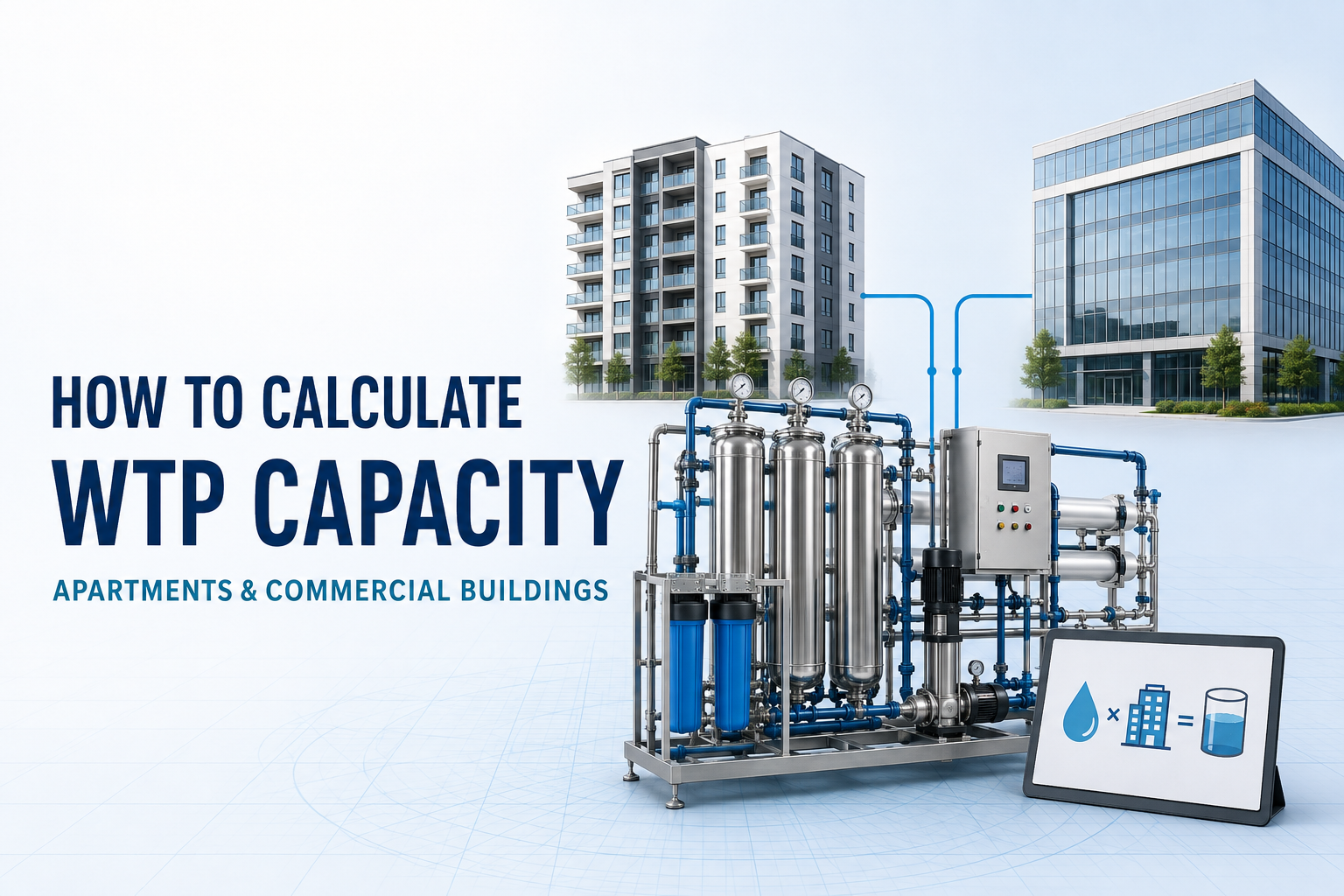
Accurate WTP capacity calculation is essential when planning a water treatment plant for apartments, offices, hotels, and commercial buildings. An undersized plant may fail to meet peak demand, while an oversized system can increase installation and operating costs.
The calculation starts with estimating daily water demand based on occupancy, per-person consumption, building use, losses, and peak requirements. Source-water quality and the quantity requiring treatment must also be considered.
For projects in India and Bangalore, WTP planning should follow applicable standards, local authority requirements, and project-specific conditions. This guide explains practical capacity calculation methods with examples for residential and commercial buildings, along with the importance of Water Treatment Plant Services in Bangalore for efficient and reliable water treatment.
What Is WTP Capacity?
WTP capacity is the quantity of water a Water Treatment Plant can treat over a specified period, usually expressed in litres per day (LPD), kilolitres per day (KLD), or cubic metres per day (m³/day).
For building projects, WTP capacity is generally determined from the quantity of raw water that needs to be treated to meet the required treated-water demand. The calculation should not be based only on the number of apartments or the built-up area.
The basic relationship is:
WTP Capacity ≈ Required Daily Treated Water Demand ÷ Effective Operating Time
For example, if a project needs 300 KLD of treated water and the treatment plant effectively operates for 20 hours per day, the required instantaneous treatment rate would be approximately:
300 ÷ 20 = 15 KLD/hour
The final plant configuration, however, requires engineering consideration of process flow, storage, operating hours, peak factors, backwashing, reject water, redundancy, and source-water quality.
Why Is WTP Capacity Calculation Important?
Correct sizing helps the building maintain a dependable treated-water supply without unnecessarily installing excessive treatment capacity.
A properly sized plant can help with:
- Meeting normal and peak water demand
- Maintaining consistent treatment performance
- Avoiding unnecessary capital expenditure
- Reducing energy and chemical consumption
- Planning raw-water and treated-water storage
- Selecting appropriate pumps and treatment equipment
- Allowing for future occupancy or expansion
- Improving operational reliability
The capacity of a treatment plant should therefore be treated as part of the overall building water system rather than as an isolated equipment-selection exercise.
What Factors Determine WTP Capacity?
The most important factors are population, water consumption, building type, non-domestic demand, peak demand, losses, operating hours, and future requirements.
1. Occupancy
For residential projects, estimate the expected number of residents rather than simply counting apartments.
For example:
- Number of apartments = 200
- Design occupancy = 4 persons per apartment
- Estimated population = 200 × 4
- Total population = 800 persons
The assumed occupancy should be based on the project’s planning criteria and applicable regulations rather than an arbitrary number.
2. Per-Capita Water Demand
For residential water-supply planning, Indian guidance commonly uses 135 litres per capita per day (LPCD) for residences with flushing systems. CPHEEO’s 2024 engineering manual specifically references the 135 LPCD recommendation from IS 1172 for such residences.
However, this value should be treated as a planning basis, not automatically as the WTP size. The actual project may have additional requirements for landscaping, common areas, commercial facilities, amenities, or other uses.
3. Building Type
Water demand varies significantly according to the building’s function.
An apartment complex may primarily require water for domestic use and common facilities, while an office building can have substantial demand from washrooms, cafeterias, housekeeping, cooling systems, and other operations.
This is why the commercial building water requirement must be calculated according to actual occupancy and building activities rather than applying a residential assumption.
4. Peak Demand
Water consumption is not uniform throughout the day. Residential demand commonly rises during morning and evening periods, while commercial buildings may have different demand patterns.
CPHEEO identifies daily and hourly variation as important factors in water-demand planning.
The treatment system and storage arrangement should therefore be evaluated together instead of assuming that the average daily demand represents every hour of operation.
5. Water Losses and Process Requirements
The water entering a WTP is not always equal to the final quantity delivered as usable treated water.
Depending on the treatment technology, additional water may be required for:
- Filter backwashing
- Membrane cleaning
- Reject or concentrate streams
- Sludge handling
- Equipment cleaning
- Other process operations
These requirements need to be incorporated into the engineering design where applicable.
How to Perform WTP Capacity Calculation Step by Step
A practical WTP capacity calculation can be performed by following these steps.
Step 1: Estimate the Design Population
For an apartment project:
Design Population = Number of Dwelling Units × Design Occupancy per Unit
Example:
200 apartments × 4 persons = 800 persons
Step 2: Calculate Domestic Water Demand
Use the applicable per-capita design basis.
Using 135 LPCD as an illustrative residential planning basis:
800 × 135 = 108,000 litres/day
Therefore:
Domestic demand = 108 KLD
The applicable design standard and local approval requirements should always be confirmed for the specific project.
Step 3: Add Common-Area Requirements
Apartments may have additional water demand from common facilities such as:
- Clubhouses
- Swimming pools
- Landscaping
- Security facilities
- Housekeeping
- Community halls
- Maintenance areas
These should be calculated separately wherever reliable design data is available.
Step 4: Add Commercial or Institutional Demand
If the development contains shops, offices, restaurants, schools, healthcare facilities, or other uses, estimate their demand separately.
For example:
Residential demand = 108 KLD
Common-area demand = 20 KLD
Other building demand = 15 KLD
Total estimated demand:
108 + 20 + 15 = 143 KLD
This gives a more realistic design basis than multiplying the number of flats by a single fixed number.
Step 5: Account for Peak and Operational Conditions
The average daily demand does not necessarily equal the required plant throughput.
Consider:
- Peak-day demand
- Peak-hour demand
- Plant operating hours
- Raw-water availability
- Storage capacity
- Treatment-process limitations
- Future expansion
A storage tank can sometimes help balance variations between production and consumption, but it should not be used to hide an incorrectly sized treatment process.
Step 6: Determine the Required WTP Design Capacity
If the calculated treated-water requirement is 143 KLD and the plant is intended to operate for 20 effective hours per day:
Required treatment rate = 143 ÷ 20 = 7.15 KLD/hour
That is approximately:
7.15 m³/hour
The final selected plant capacity may then be adjusted according to engineering design, operating philosophy, redundancy, future demand, and equipment constraints.
Example: Water Demand Calculation for Apartments
Consider a residential development with:
- 300 apartments
- 4 persons per apartment
- 135 LPCD planning basis
- Additional common-area requirement of 30 KLD
Population
300 × 4 = 1,200 persons
Domestic Demand
1,200 × 135 = 162,000 litres/day
= 162 KLD
Total Demand
162 KLD + 30 KLD = 192 KLD
Therefore, the project’s preliminary treated-water demand is approximately 192 KLD, before considering project-specific process losses, peak requirements, storage strategy, and other engineering factors.
This example illustrates why water demand calculation for apartments should begin with occupancy and then add relevant non-domestic requirements.
How Is WTP Capacity Different for Commercial Buildings?
Commercial projects require a more activity-based approach because occupancy and water use can vary considerably.
For an office building, for example, the design team may need to consider:
- Number of employees
- Visitors
- Working hours
- Washroom facilities
- Cafeteria or food service
- Housekeeping
- Cooling systems
- Landscaping
- Other operational uses
A shopping centre, hotel, hospital, or industrial facility will have a completely different demand profile.
The water treatment plant capacity calculation should therefore use the actual function of the building and its expected water-consuming activities.
Commercial Building Example
Suppose an office development has a design population of 1,000 people.
If the applicable planning criterion indicates 45 litres per person per day for the relevant use, the basic demand would be:
1,000 × 45 = 45,000 litres/day
= 45 KLD
If additional demand from housekeeping and other approved uses is estimated at 10 KLD:
Total = 55 KLD
This is only an illustrative calculation. The actual design criterion should be established from the applicable building type, authority requirements, and project specifications.
WTP Design Capacity vs Daily Water Demand
These two terms should not be treated as identical.
Daily water demand represents the quantity of water required over a day.
WTP design capacity represents the treatment system’s ability to process water at the required rate under the selected operating conditions.
For example:
| Parameter | Illustrative Value |
| Average daily demand | 200 KLD |
| Effective operating period | 20 hours/day |
| Average treatment rate | 10 KLD/hour |
| Equivalent flow | 10 m³/hour |
The final plant capacity may differ after considering peak demand, process losses, equipment redundancy, storage, maintenance requirements, and future expansion.
What Should Be Considered for Bangalore Projects?
For projects in Bangalore, WTP sizing should be coordinated with the overall water-supply strategy and applicable requirements of the Bangalore Water Supply and Sewerage Board (BWSSB) and other relevant authorities.
BWSSB’s current online connection system lists building-related documents and requirements, including building plans and, where applicable, rainwater harvesting and STP-related documentation.
The local water source should also be clearly identified. Depending on the project, the water system may involve municipal supply, borewell water where legally permitted, tanker supply, treated/recycled water, or a combination.
For Bangalore developments, designers should also evaluate:
- Availability and reliability of source water
- Raw-water quality
- Storage capacity
- Rainwater harvesting requirements
- Reuse of treated wastewater
- STP and WTP integration
- Authority approval requirements
- Future occupancy
- Seasonal variations
BWSSB also highlights rainwater harvesting requirements for specified property sizes, making water-source planning an important part of building-level water management.
How to Choose the Right WTP Capacity
The right capacity should come from a documented water-demand study rather than a standard plant size selected solely by habit.
Before finalizing the system, review:
- Design population and occupancy
- Building usage
- Applicable water-demand norms
- Daily and peak demand
- Source-water availability
- Raw-water quality
- Required treated-water quality
- Storage volume
- Treatment operating hours
- Process losses
- Redundancy and maintenance requirements
- Future expansion requirements
For larger projects, the hydraulic design should be prepared and reviewed by qualified water-treatment and plumbing professionals.
What Does a WTP Cost?
WTP cost cannot be determined accurately from capacity alone. Two plants with the same nominal capacity can have different costs because the treatment process, raw-water quality, technology, and site conditions may vary.
Major cost factors include:
- Raw-water quality and treatment requirements
- Plant capacity and operating hours
- Filtration or membrane technology
- Chemical dosing systems
- Pumps and electrical equipment
- Automation level
- Civil works and storage tanks
- Installation and commissioning
- Operation and maintenance requirements
A basic filtration system and an advanced membrane-based system should therefore not be compared solely on KLD capacity.
Expert Tips for Better WTP Planning
A reliable WTP design starts with an accurate assessment of the building’s water demand. Consider these key factors:
- Use realistic design occupancy and consumption data.
- Separate residential, commercial, institutional, and amenity requirements.
- Assess source-water quality before selecting the treatment process.
- Consider peak demand, operating hours, and storage capacity.
- Include water required for backwashing and other treatment processes.
- Allow for future expansion where applicable.
- Check relevant BIS, CPHEEO, NBC, and local authority requirements.
- Coordinate WTP planning with STP, rainwater harvesting, and water-reuse systems.
- Get the final hydraulic and treatment design reviewed by a qualified professional.
The National Building Code of India 2016 includes provisions related to building services, including water supply, drainage, and sanitation. Following applicable standards during planning can support system reliability and regulatory compliance.
Conclusion
Accurate WTP capacity calculation helps PRKGlobal360 ensure that apartments and commercial buildings receive adequate treated water without unnecessary over-sizing. The process should consider occupancy, daily demand, peak requirements, source-water quality, storage, treatment losses, and future needs.
For projects in India and Bangalore, local authority requirements should also be reviewed before finalizing the plant. A properly prepared water-demand assessment, supported by professional hydraulic and process design, can help create an efficient and dependable water-treatment system.
Plan the Right WTP Capacity for Your Building
Choosing the right water treatment plant capacity requires careful assessment of water demand, source quality, storage, treatment requirements, and future needs. Professional guidance can help ensure the system is designed efficiently for your apartment or commercial project. Contact our experts today to discuss your WTP requirements and get a solution tailored to your building.
Call or WhatsApp: +91 96061 71055
Email: prkmanagement.blr@gmail.com
Frequently Asked Questions
1. What is the basic formula for calculating WTP capacity?
WTP capacity is estimated by dividing required daily treated-water demand by effective operating hours, while considering peak demand, process losses, storage, and future requirements.
2. Is 135 LPCD applicable to every building?
No. 135 LPCD is commonly used for residential planning. Commercial, institutional, industrial, and specialised buildings require demand criteria based on their specific usage.
3. Should WTP capacity be based on peak or average demand?
Both should be considered. Average demand determines daily requirements, while peak demand helps ensure the treatment and storage systems can handle higher consumption periods.
4. Does a WTP need extra capacity for backwashing?
Yes, depending on the treatment technology. Water used for filter backwashing, cleaning, and other processes should be considered during hydraulic and capacity planning.
5. How is WTP capacity calculated for an apartment complex?
Calculate the design population, apply the appropriate per-capita demand, add common-area requirements, and consider peak demand, process losses, storage, and future expansion.
6. Does Bangalore have additional requirements for building water systems?
Yes. Bangalore projects may need to follow applicable BWSSB requirements concerning water connections, building plans, rainwater harvesting, STP systems, and other water-management provisions.
7. Can WTP and STP capacity be the same?
Not necessarily. WTP capacity depends on treated-water demand, while STP capacity depends on wastewater generation. Both should be calculated separately based on project requirements.
 Chat on WhatsApp