
Commercial buildings need cleaning systems that maintain hygiene, appearance, safety, and day-to-day operational efficiency. As offices, hospitals, hotels, business parks, factories, and residential communities become larger, choosing between traditional cleaning and mechanized cleaning services can have a significant impact on how efficiently cleaning tasks are completed.
Manual cleaning remains useful for detailed tasks, restricted spaces, and areas that require close attention. Mechanized methods, meanwhile, can support faster and more consistent cleaning of large surfaces. For commercial properties in Bangalore, where buildings can experience high footfall and demanding maintenance schedules, understanding the difference between the two approaches can help facility managers make better decisions when choosing housekeeping services in Bangalore.
Call or WhatsApp: +91 96061 71055
What Are Mechanized Cleaning Services for Commercial Buildings?
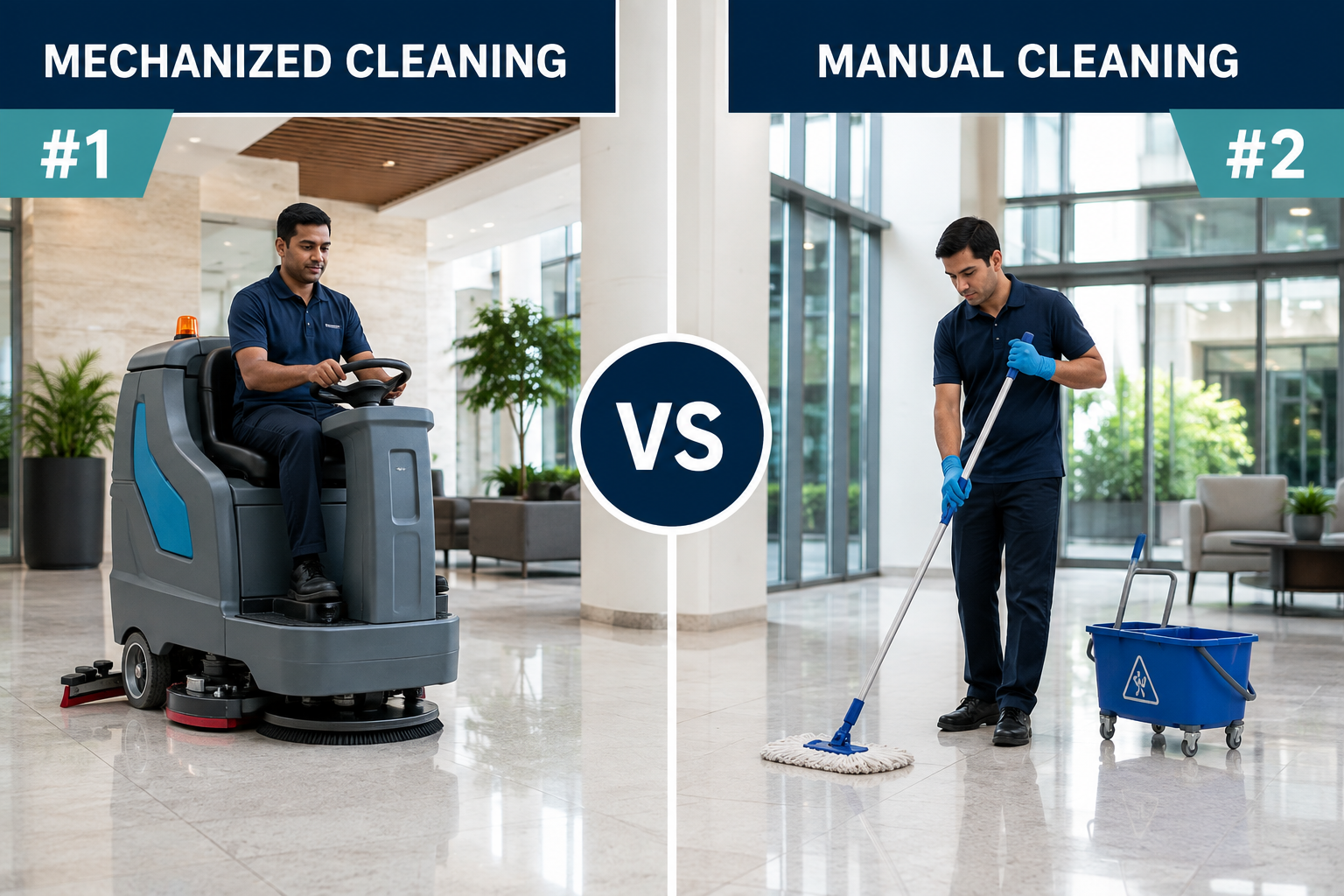
Mechanized cleaning uses powered equipment to perform or assist with cleaning activities that might otherwise require substantial manual effort. Depending on the facility, this can include vacuuming, sweeping, scrubbing, drying, polishing, or pressure cleaning.
The main advantage is that machines can help cleaning teams cover large areas more consistently while reducing repetitive physical work. However, machines do not eliminate the need for trained personnel. Operators still need to select suitable equipment, use it correctly, maintain the machines, and handle areas that require manual attention.
Common equipment used in commercial facilities includes:
- Vacuum cleaners
- Scrubber-dryers
- Single-disc machines
- Mechanical sweepers
- High-pressure cleaning systems
- Carpet cleaning machines
- Floor polishing equipment
The appropriate equipment depends on the building layout, surface type, cleaning frequency, and level of traffic.
What Is Manual Cleaning?
Manual cleaning involves using hand-operated tools and conventional cleaning techniques. Sweeping, mopping, dusting, wiping, scrubbing, and spot cleaning are common examples.
Manual methods are particularly useful where cleaning requires precision or where machines cannot easily reach. Corners, narrow spaces, fixtures, furniture, stairs, sensitive surfaces, and small areas may still require direct attention from cleaning staff, making them an important part of Soft Services in Bangalore.
Manual cleaning can also be practical for smaller premises where purchasing, storing, and maintaining large equipment may not be justified.
The key point is that manual cleaning is not automatically inferior. Its suitability depends on the task, building, surface, available workforce, and required cleaning frequency.
Manual vs Mechanized Cleaning: What Is the Difference?
The main difference is how cleaning work is performed. Manual cleaning depends primarily on human effort and hand-operated tools, while mechanized cleaning uses powered equipment to perform specific tasks more efficiently.
| Factor | Manual Cleaning | Mechanized Cleaning |
| Large-area coverage | More time-consuming | Generally faster |
| Labour involvement | Higher physical involvement | Operators manage equipment |
| Detailed cleaning | Highly suitable | May require manual support |
| Large floor areas | Can require more time | Well suited to machine cleaning |
| Equipment investment | Relatively limited | Requires equipment investment |
| Consistency | Depends on individual technique | Machine operation can improve consistency |
| Corners and restricted spaces | Highly suitable | Often needs manual support |
| Maintenance | Mainly hand tools | Equipment requires servicing and care |
For most large commercial properties, the choice does not have to be completely one-sided. A combination of both approaches can provide more practical coverage.
What Are the Benefits of Mechanized Cleaning Services?
Mechanized cleaning services can help commercial facilities improve cleaning productivity, consistency, and coverage, particularly when large areas or repetitive floor-cleaning tasks are involved. Their value depends on selecting appropriate equipment and using it correctly.
Faster Cleaning of Large Areas
Large offices, manufacturing facilities, hotels, and business parks may have extensive floor areas that need frequent cleaning. Machines can cover these areas systematically, making them useful for routine cleaning schedules.
For example, a scrubber-dryer can combine scrubbing and water recovery in one operation. This can reduce the number of separate manual steps required for suitable floor surfaces.
More Consistent Cleaning
Manual cleaning results can vary depending on technique, fatigue, tools, and working conditions. Properly operated equipment can provide a more standardized cleaning process for repetitive tasks.
Consistency is particularly valuable in high-traffic areas where floors need regular attention throughout the working week.
Reduced Physical Strain
Cleaning involves repetitive activities such as sweeping, mopping, and scrubbing. Appropriate machinery can reduce some of this physical workload.
This does not mean that machines remove the need for cleaning personnel. Instead, they can allow trained staff to focus their effort on equipment operation, detailed cleaning, inspection, and areas that cannot be machine-cleaned.
Better Support for High-Traffic Facilities
Buildings such as corporate campuses, hospitals, hotels, educational institutions, and shopping or business facilities often experience continuous movement of people.
Mechanized methods can be particularly useful for routine floor maintenance in these environments because large areas may need to be cleaned regularly without disrupting normal operations.
What Types of Equipment Are Used for Commercial Cleaning?
Different cleaning tasks require different machines. Choosing equipment based only on size or price can lead to inefficient cleaning and unnecessary operating costs.
Industrial cleaning equipment commonly used in larger facilities may include:
- Industrial vacuum cleaners for dust and debris
- Scrubber-dryers for suitable hard floors
- Sweepers for collecting dry debris
- Single-disc machines for scrubbing or polishing
- High-pressure systems for appropriate outdoor or heavy-duty cleaning
- Carpet extraction machines for textile surfaces
- Floor polishing equipment for specific maintenance requirements
Commercial floor cleaning machines are particularly useful where large floor areas need routine maintenance. However, the equipment must match the floor material and cleaning requirement. A machine designed for one surface may not be suitable for another.
Facility teams should also consider machine dimensions, storage space, power or battery requirements, operator training, maintenance needs, noise levels, and access restrictions.
When Should Commercial Buildings Choose Mechanized Cleaning?
Mechanized methods are generally most useful when a facility has large areas, frequent cleaning requirements, repetitive floor-maintenance tasks, or high levels of foot traffic.
They can be particularly relevant for:
- Corporate offices and IT campuses
- Manufacturing and industrial facilities
- Hospitals and healthcare buildings
- Hotels and hospitality properties
- Business parks
- Residential apartments and housing societies
- Educational institutions
- Pharma and life sciences facilities
- Data centres and high-security facilities
For sensitive environments, cleaning plans should account for access restrictions, equipment suitability, noise, contamination-control procedures, and operational requirements.
For example, a data centre may have strict access protocols, while a hospital may require cleaning procedures that account for hygiene and patient-care environments. The cleaning method should therefore be selected according to the facility rather than simply following a standard equipment list.
Can Manual and Mechanized Cleaning Be Used Together?
Yes. A hybrid cleaning strategy can often be more practical than relying entirely on one method.
Machines can handle large open floors, while manual cleaning can take care of detailed areas and surfaces that equipment cannot reach.
A typical commercial cleaning plan might use:
- Machines for large floor areas.
- Manual mopping around corners and obstacles.
- Equipment for routine scrubbing.
- Manual wiping of desks, fixtures, and touchpoints.
- Spot cleaning for spills and isolated stains.
- Manual cleaning around sensitive or restricted areas.
This approach allows facility managers to use equipment where it provides the greatest benefit while retaining human attention for tasks that require precision.
How to Choose the Right Cleaning Approach for a Commercial Building
Choosing a cleaning method should begin with the actual requirements of the property rather than the availability of a particular machine.
1. Assess the Total Floor Area
Large floor areas may benefit more from powered equipment than small premises.
2. Identify Surface Types
Tile, concrete, stone, vinyl, carpet, and other materials may require different cleaning methods and equipment.
3. Consider Foot Traffic
High-traffic locations usually require more frequent cleaning and may benefit from efficient floor-maintenance systems.
4. Review Cleaning Frequency
A building cleaned several times a day has different requirements from one that needs routine cleaning only once a day.
5. Evaluate Manpower
Consider the number of cleaning personnel available and the amount of physical work involved in recurring tasks.
6. Check Equipment Requirements
Consider storage, charging or power requirements, maintenance, operator training, and availability of replacement parts.
7. Consider Building Operations
Cleaning schedules should fit around working hours, patient movement, guest activity, production operations, or other building-specific requirements.
8. Compare Long-Term Costs
Look beyond the initial equipment cost. Labour, maintenance, consumables, energy, training, and equipment lifespan can all influence the overall operating model.
For businesses looking for professional facility management services, cleaning requirements should ideally be assessed alongside the broader maintenance schedule.
What Factors Affect the Cost of Commercial Cleaning?
There is no single price that applies to every commercial cleaning project. Costs depend on the property’s size, layout, cleaning frequency, surfaces, workforce, equipment requirements, and complexity of the work.
Important cost factors include:
- Total cleaning area
- Number of floors
- Cleaning frequency
- Type and condition of surfaces
- Required manpower
- Equipment requirements
- Operating hours
- Specialised cleaning requirements
- Consumables
- Equipment maintenance
A machine-based approach may require greater initial investment in equipment, while manual cleaning may involve greater recurring labour requirements for certain large-scale tasks. Therefore, businesses should compare the total operational requirements rather than focusing on one expense.
Common Mistakes When Selecting a Cleaning Method
Businesses can face avoidable problems when they select a cleaning approach without considering their actual facility requirements.
Common mistakes include:
- Selecting equipment only because it has a lower purchase price
- Ignoring the type of flooring
- Using unsuitable machines on sensitive surfaces
- Failing to train operators
- Neglecting routine equipment maintenance
- Assuming machines can handle every cleaning task
- Ignoring corners, stairs, and restricted areas
- Not considering cleaning schedules during operating hours
- Failing to review long-term operating requirements
A proper cleaning assessment should consider the entire building rather than focusing on one area or one piece of equipment.
Which Cleaning Method Is Better for Commercial Buildings?
Neither method is universally better. The right choice depends on the size of the facility, surface types, cleaning frequency, traffic levels, manpower, hygiene requirements, and operating conditions.
Mechanized methods are generally useful for large areas and repetitive cleaning tasks where equipment can improve productivity and consistency. Manual cleaning remains essential for detailed work, tight spaces, sensitive surfaces, and tasks requiring close visual attention.
For many commercial properties, combining both methods provides a balanced solution. The objective should be effective, safe, and consistent cleaning rather than replacing one approach with another simply for the sake of automation.
What Is the Future of Commercial Building Cleaning?
Commercial cleaning is gradually becoming more equipment-driven, particularly as businesses look for better productivity and more structured facility management.
Future developments may include:
- More efficient battery-powered machines
- Improved equipment ergonomics
- Smarter machine monitoring
- Greater use of automation in suitable facilities
- Data-supported facility management
- More efficient water and energy use
- Improved operator safety
- Increased use of robotic cleaning for suitable open environments
Automation is unlikely to eliminate every manual cleaning task. Human oversight, inspection, detailed cleaning, and decision-making will continue to be important, particularly in complex commercial environments.
Conclusion
Choosing between manual cleaning and mechanized cleaning services is ultimately a facility-management decision rather than simply an equipment decision. Large commercial properties can benefit from machine-assisted cleaning for repetitive and extensive floor-maintenance tasks, while manual methods remain valuable for detailed and hard-to-reach areas.
For businesses in Bangalore, the most effective approach should be based on the building’s layout, floor types, traffic, hygiene requirements, operating hours, and available workforce. PRKGlobal360 can help businesses assess their commercial cleaning requirements and develop a cleaning approach suited to their facility, combining professional processes, trained personnel, and appropriate equipment where required.
Looking for Reliable Facility Management Services in Bangalore?
Keep your commercial property clean, well-maintained, and professionally managed with dependable facility management solutions. Get in touch with our team to discuss your requirements and find the right services for your property.
Call or WhatsApp: +91 96061 71055
Email: prkmanagement.blr@gmail.com
Frequently Asked Questions
Is mechanized cleaning better than manual cleaning?
It depends on the building and task. Mechanized cleaning can be more suitable for large floor areas, repetitive cleaning, and high-traffic facilities. Manual cleaning remains useful for corners, detailed work, sensitive surfaces, and restricted areas. Many commercial buildings benefit from combining both methods.
Which commercial buildings benefit most from machine-based cleaning?
Large offices, hotels, hospitals, manufacturing facilities, business parks, housing societies, educational campuses, and other properties with extensive floor areas can benefit from machine-based cleaning. The suitability depends on the building layout, floor surfaces, traffic levels, cleaning frequency, and operational requirements.
Can machines completely replace manual cleaning?
No. Machines are designed for specific cleaning tasks and surfaces. Areas such as corners, narrow spaces, fixtures, furniture, stairs, and sensitive locations may still require manual attention. A hybrid approach often provides more complete coverage.
What equipment is commonly used for commercial floor cleaning?
Common equipment includes scrubber-dryers, sweepers, single-disc machines, vacuum cleaners, floor polishers, and carpet-cleaning machines. The appropriate equipment depends on the floor material, area size, level of dirt, cleaning frequency, and operational requirements of the facility.
Is mechanized cleaning suitable for hospitals and sensitive facilities?
It can be, provided the equipment, cleaning process, access procedures, and operating schedules are appropriate for the environment. Healthcare and other sensitive facilities may have additional hygiene, safety, access, and contamination-control requirements that need to be considered before equipment is selected.
What affects the cost of commercial cleaning?
Cost can depend on building size, floor type, cleaning frequency, manpower, equipment requirements, operating hours, specialised cleaning needs, consumables, and maintenance. Businesses should evaluate both immediate expenses and ongoing operating requirements before choosing a cleaning model.
Should a business choose manual, mechanized, or hybrid cleaning?
The decision should be based on the facility’s size, surfaces, traffic, cleaning frequency, manpower, and operational requirements. A hybrid model can often provide a practical balance by using machines for large repetitive tasks and manual methods for detailed or restricted areas.
 Chat on WhatsApp