

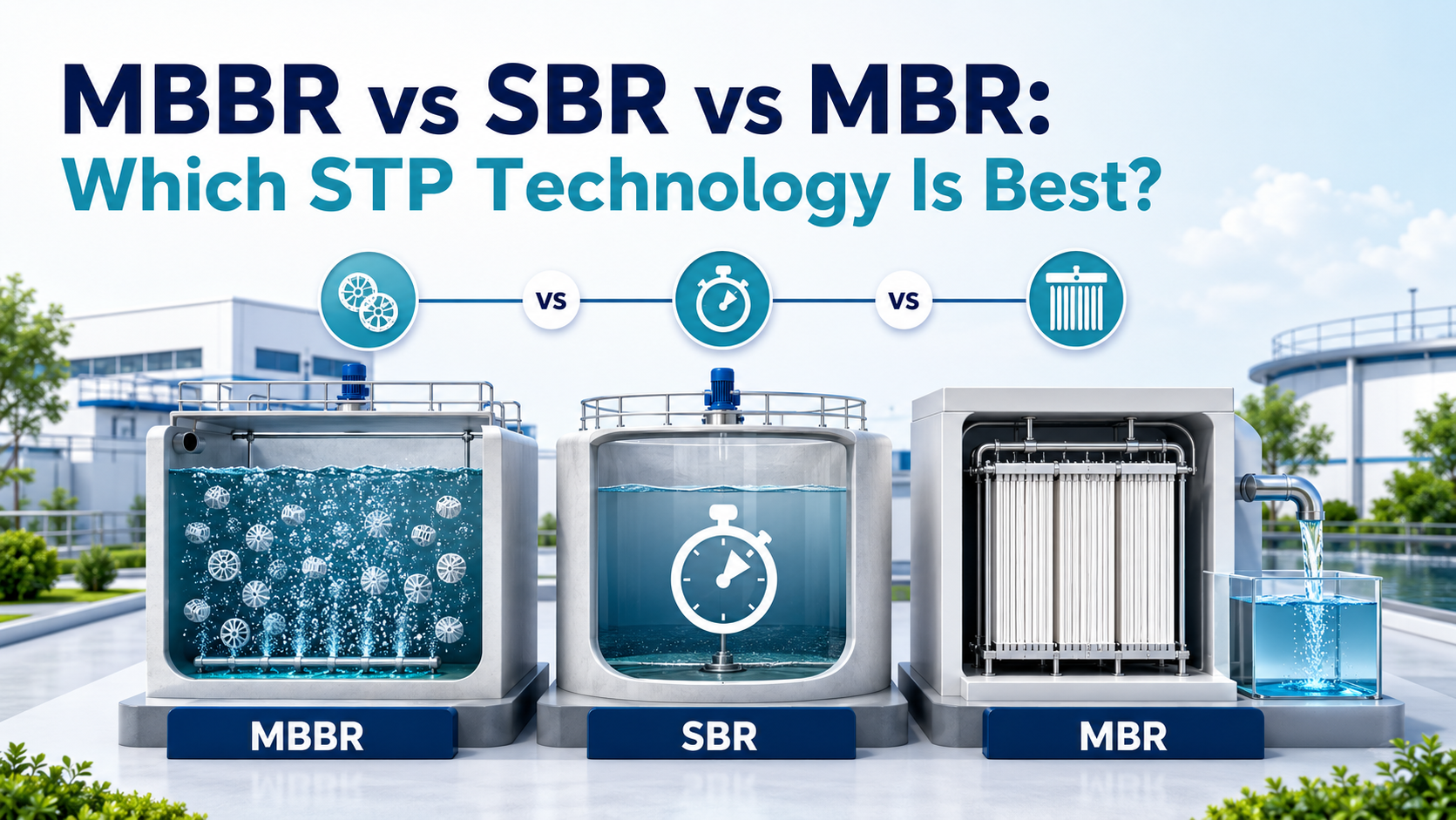
Choosing the right sewage treatment technology affects treatment performance, operating cost, maintenance requirements, space requirements and long-term reliability. For businesses, apartments, hospitals, schools, offices and industrial facilities, the decision is rarely as simple as choosing the newest technology. Proper operation and regular upkeep are equally important after installation, which is why STP Maintenance Services in Bangalore can play an important role in maintaining consistent treatment performance.
MBBR vs SBR vs MBR involves three different approaches to biological wastewater treatment. MBBR uses moving biofilm carriers, SBR treats wastewater in timed batches, while MBR combines biological treatment with membrane filtration. The right choice depends on wastewater characteristics, available space, treated water quality requirements, operating conditions, and budget.
Call or WhatsApp: +91 96061 71055
MBBR vs SBR vs MBR: What Is the Difference?
In simple terms, MBBR is a flexible continuous biological process, SBR is a batch treatment process, and MBR provides advanced treatment using membranes. None is universally “best”; the appropriate technology depends on the facility’s treatment objectives and site constraints.
| Factor | MBBR | SBR | MBR |
| Process | Continuous biological treatment | Batch biological treatment | Biological treatment + membrane separation |
| Main feature | Biofilm carriers | Time-based treatment cycles | Membrane filtration |
| Space requirement | Moderate | Moderate | Low |
| Treated-water quality | Good to high | High when properly designed | Very high |
| Operational complexity | Moderate | Moderate | Higher |
| Energy demand | Moderate | Moderate | Generally higher |
| Suitable for | Variable loads and conventional STPs | Facilities needing flexible batch operation | Reuse and stringent effluent-quality requirements |
CPCB technical material identifies SBR, MBBR and MBR among technologies capable of achieving strong treatment performance, while performance varies with design, operation and additional treatment stages.
How Does MBBR Technology Work?
MBBR, or Moving Bed Biofilm Reactor, uses small plastic carriers inside an aeration tank. Microorganisms grow on these carriers and break down organic pollutants in sewage. Aeration keeps the carriers moving and supplies oxygen needed for biological treatment.
A typical MBBR sewage treatment plant includes:
- Preliminary screening and grit removal
- Equalization, where required
- Biological treatment with carrier media
- Aeration system
- Secondary clarification or solids separation
- Tertiary treatment when required
- Disinfection and treated-water storage
Key Benefits of MBBR
- Handles variations in wastewater loading relatively well when properly designed
- Provides a large surface area for microbial growth
- Can be integrated into existing treatment systems
- Offers continuous operation
- Can be suitable where operational simplicity is important
For facilities such as commercial buildings, residential developments, institutions and factories, MBBR can be attractive when the goal is dependable biological treatment without membrane-based filtration.
How Does SBR Technology Work?
SBR, or Sequential Batch Reactor, treats wastewater in repeated cycles inside the same reactor. Instead of continuously separating biological treatment and settling into different tanks, an SBR typically follows stages such as fill, react, settle, decant and idle.
The SBR sewage treatment process can provide considerable flexibility because treatment conditions can be adjusted through cycle timing.
Key Benefits of SBR
- Combines several treatment functions in one reactor
- Can support biological nitrogen removal when appropriately designed
- Offers flexibility through programmable operating cycles
- Can produce good effluent quality
- Can be useful where hydraulic flow varies over time
SBR can be particularly relevant for facilities where wastewater generation fluctuates rather than remaining constant throughout the day.
How Does MBR Technology Work?
MBR, or Membrane Bioreactor, combines biological wastewater treatment with membrane separation. Instead of relying primarily on conventional settling for final solids separation, membranes physically separate treated water from suspended solids and microorganisms.
A typical MBR system may include:
- Preliminary screening
- Biological treatment
- Fine screening or membrane protection
- Membrane filtration
- Disinfection or polishing, where required
- Treated-water storage and reuse
The main advantage is the quality of the membrane-separated effluent and the ability to achieve high solids removal in a relatively compact treatment footprint. CPCB material reports strong performance potential for MBR in terms of BOD, suspended solids and coliform removal, depending on the overall treatment configuration.
The trade-off is that membranes require careful operation, cleaning and monitoring. Energy consumption can also be higher because of aeration and membrane-related operating requirements.
Which STP Technology Is Best for Your Facility?
The best technology depends on five factors: wastewater flow, wastewater characteristics, available space, required treated-water quality and operating budget. A facility manager should evaluate the complete lifecycle rather than selecting a system based only on installation cost.
Choose MBBR When:
MBBR may be suitable when you need:
- A continuous biological treatment process
- Flexibility for variable organic loading
- A practical solution for conventional sewage treatment
- The possibility of upgrading an existing biological treatment system
- Manageable operational requirements
Choose SBR When:
SBR may be appropriate when:
- Wastewater flow changes significantly during the day
- Batch-based operation fits the facility
- Biological nitrogen removal is an important consideration
- Automated cycle control is acceptable
- The site can accommodate the required reactor configuration
Choose MBR When:
An MBR wastewater treatment system may make more sense when:
- Space is highly constrained
- High-quality treated water is required
- Water reuse is a major objective
- Low suspended solids in the final effluent are important
- The facility can support higher operational and maintenance requirements
MBBR vs SBR vs MBR: Cost and Maintenance Factors
There is no universal price difference because STP costs depend on capacity, civil construction, equipment selection, automation, influent quality, land availability, tertiary treatment and reuse requirements.
Consider these cost areas:
- Initial civil and mechanical installation
- Pumps and blowers
- Electrical consumption
- Chemical consumption
- Sludge handling
- Spare parts
- Operator requirements
- Preventive maintenance
- Membrane replacement, where applicable
- Laboratory testing and compliance monitoring
The cheapest installation is not necessarily the lowest-cost option over its operating life. A lifecycle-cost assessment should compare capital expenditure with energy, manpower, maintenance, consumables and expected replacement requirements.
What Should You Check Before Selecting STP Technology?
Before finalizing an STP design, facility and procurement teams should evaluate:
- Design flow: Average and peak sewage flow must be established.
- Wastewater quality: Organic load and other characteristics influence biological-process design.
- Space availability: Compact solutions may be valuable at space-constrained sites.
- Reuse objective: Flushing, gardening, cooling or other reuse applications may require additional treatment.
- Discharge requirements: The final system should be designed around applicable consent and discharge requirements.
- Power availability: Aeration and pumping requirements affect operating costs.
- Maintenance capability: Technology should match the site’s available technical manpower.
- Future expansion: Consider expected changes in occupancy or production.
CPCB has published technical material comparing sewage-treatment technologies and emphasizes operation at designed capacity and compliance with applicable discharge requirements.
Before finalizing an STP design, facility and procurement teams should evaluate the complete wastewater treatment requirement, including sewage flow, wastewater characteristics, available space, treated-water reuse objectives, power availability and maintenance capabilities. For facilities that require both sewage and broader water-treatment solutions, Water Treatment Plant Services in Bangalore can also be considered based on the site’s overall water management requirements.
Common STP Selection Mistakes to Avoid
A technically suitable technology can still perform poorly if the plant is incorrectly designed or operated.
Common mistakes include:
- Selecting capacity only from average flow
- Ignoring peak flow conditions
- Underestimating wastewater characteristics
- Choosing equipment without considering lifecycle costs
- Poor aeration-system sizing
- Insufficient screening before sensitive treatment equipment
- Neglecting sludge management
- Inadequate operator training
- Failing to plan preventive maintenance
- Selecting a technology without considering the final water-use objective
For facilities in Bangalore and across India, local site conditions, applicable regulatory requirements and the intended reuse or discharge route should be considered during system design.
So, Which One Should You Choose?
MBBR is often a practical choice for flexible continuous biological treatment, SBR can suit facilities with variable flows and programmable batch operation, while MBR is better suited to compact installations and applications demanding high-quality treated water.
The decision should therefore be based on performance requirements, space, flow variation, energy consumption, maintenance capability and lifecycle cost, rather than technology popularity alone.
For a reliable STP technology comparison, facility managers should first define the required treated-water quality and then evaluate which process can achieve it consistently under actual operating conditions.
Conclusion
Selecting between these three treatment approaches should be based on site-specific engineering requirements rather than a simple technology ranking. MBBR can offer practical continuous biological treatment, SBR provides flexible batch-based operation, and MBR can deliver high-quality effluent with a compact footprint.
For businesses, hospitals, offices, schools, factories and large facilities in Bangalore or elsewhere in India, the right STP should balance treatment performance with energy use, maintenance, space and lifecycle cost.
PRKGlobal360 can assist businesses and facility teams with STP-related requirements, including system evaluation, operation and maintenance planning. Contact the team to discuss your site’s specific wastewater-treatment needs.
Need Help Choosing the Right STP Technology?
Choosing between MBBR, SBR and MBR depends on your facility’s wastewater flow, space, treatment requirements and maintenance needs. PRKGlobal360 can help you evaluate your STP requirements and identify a practical solution for your facility in Bangalore and across India.
Call or WhatsApp: +91 96061 71055
Email: prkmanagement.blr@gmail.com
Frequently Asked Questions
Is MBBR better than SBR for sewage treatment?
Neither technology is universally better. MBBR provides continuous biological treatment using attached-growth media, while SBR operates through controlled treatment cycles. The better option depends on flow variation, available space, required treatment performance, automation requirements and operating capability.
Is MBR suitable for commercial buildings?
MBR can be suitable for commercial buildings where space is limited or high-quality treated water is required for reuse. However, membrane systems generally need more careful monitoring, cleaning and maintenance than conventional biological treatment systems. A site-specific assessment should be completed before selection.
Which STP technology requires more maintenance?
Maintenance requirements depend on plant design and operating conditions. MBR generally requires more specialized maintenance because membranes need monitoring, cleaning and eventual replacement. MBBR and SBR also require routine blower, pump, instrumentation, sludge and biological-process management.
Can treated STP water be reused?
Yes, treated sewage can be reused for suitable non-potable applications when the treatment process and final water quality are appropriate. Common applications can include toilet flushing, landscaping and certain utility uses. The required polishing and disinfection depend on the intended application and applicable requirements.
What affects the cost of an STP?
STP cost depends on treatment capacity, influent characteristics, civil construction, equipment quality, automation, land availability, tertiary treatment, sludge handling and the intended reuse or discharge standard. Operating costs such as electricity, manpower, chemicals and maintenance should also be included in lifecycle evaluation.
How do I select the right STP for a factory or hospital?
Start with a detailed assessment of flow, wastewater characteristics, peak loads, available space, treated-water requirements, discharge conditions and operational resources. Hospitals and factories may also require additional pretreatment or specialized considerations depending on the nature of their wastewater.
 Chat on WhatsApp