

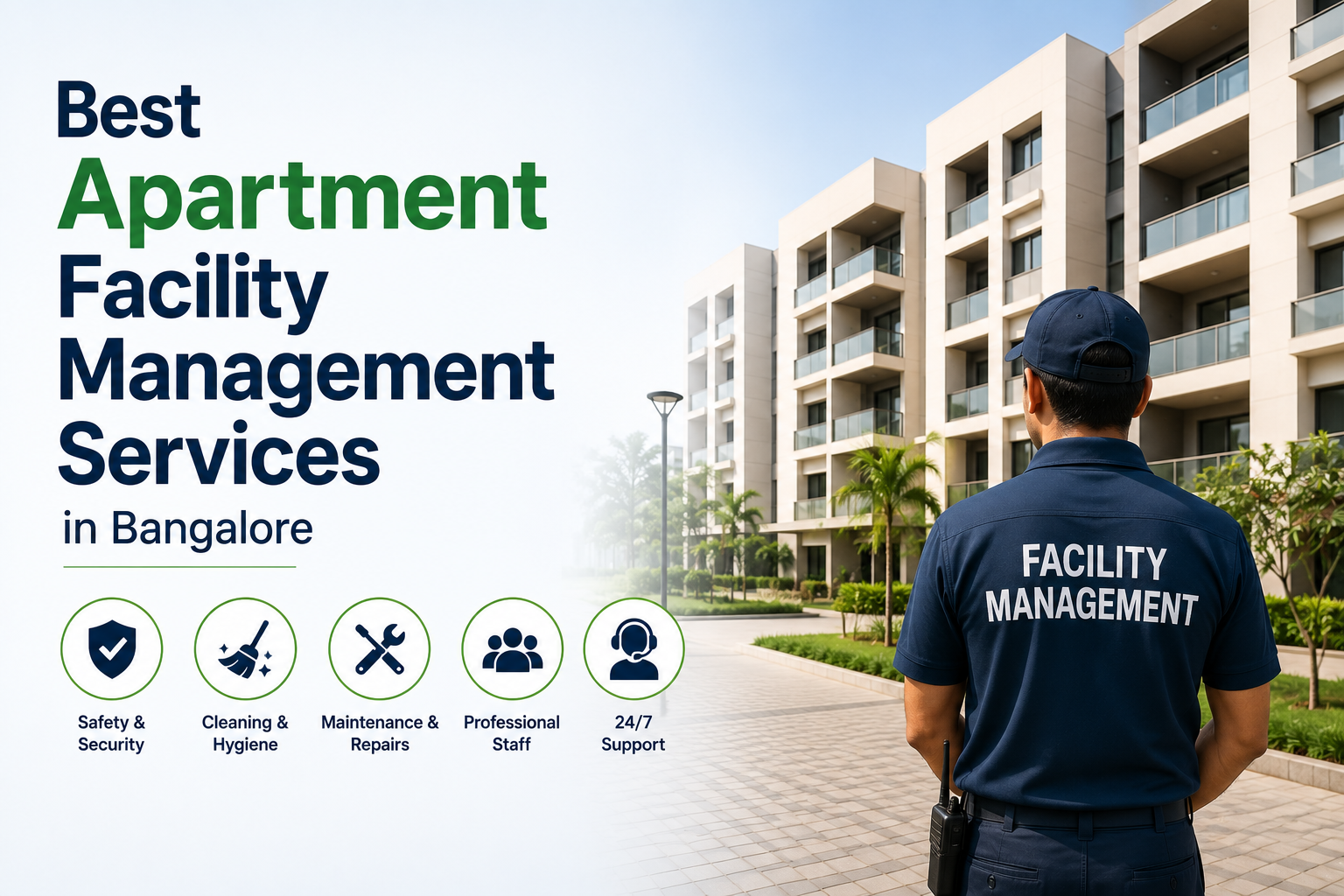
Managing an apartment community requires much more than cleaning common areas and attending to occasional repairs. A modern residential property operates through multiple interconnected functions, including housekeeping, electrical and plumbing maintenance, security, water systems, generators, landscaping, waste handling, fire and safety systems, vendor coordination and resident support.
When these activities are handled without a structured operating process, apartment associations may face repeated complaints, delayed repairs, inconsistent service quality and difficulty tracking responsibilities.
Professional Apartment Facility Management Services in Bangalore help apartment associations and Resident Welfare Associations (RWAs) organize these day-to-day operations under a planned management system.
However, selecting a facility management company should not be based only on manpower numbers or the lowest quotation.
The right approach is to understand the property, define the scope, establish service expectations and evaluate how the FM provider will manage people, assets, complaints, vendors and reporting.
This guide explains what apartment associations should consider before selecting a facility management partner in Bangalore.
Call or WhatsApp: +91 70739 69843
What Is Apartment Facility Management?
Apartment facility management is the coordinated management of services required to keep a residential property clean, safe, functional and properly maintained.
Depending on the size and infrastructure of the community, the scope may include:
- Housekeeping and common-area cleaning
- Electrical and plumbing maintenance
- Preventive maintenance
- Security management
- Landscaping and garden maintenance
- Waste-management support
- STP and WTP operations
- Generator and utility monitoring
- Fire and safety coordination
- Vendor and AMC management
- Pest-control coordination
- Resident complaint management
- Operational reporting
The exact requirements differ from one residential community to another.
A small apartment building may require a relatively simple operating structure, while a large gated community with multiple towers, basements, clubhouses, landscaped zones and technical infrastructure may need dedicated supervisors, technicians and service teams.
That is why apartment facility management should begin with an assessment of the property rather than a standard manpower package.
Start With a Property Assessment
Before finalizing an FM contract, the service provider should understand what needs to be managed.
A useful site assessment should examine the number of blocks or towers, floors, common areas, basements, clubhouses, amenities, entrances, parking areas, utility rooms, landscaped spaces and other operational zones.
The technical infrastructure also needs to be reviewed.
This can include water pumps, electrical panels, generators, sewage-treatment systems, water-treatment systems, fire equipment, plumbing networks and other common-area assets.
The purpose of the assessment is simple: determine the actual workload.
Without this step, manpower and service schedules may be based on assumptions rather than the requirements of the property.
Define the Facility Management Scope Clearly
One of the biggest causes of disagreement between apartment associations and facility management companies is an unclear scope of work.
The contract should explain exactly what the FM provider is responsible for.
For example, housekeeping should not simply be described as “common-area cleaning.” The scope should identify areas to be cleaned, cleaning frequencies, deep-cleaning responsibilities, waste-handling responsibilities, required equipment and supervision.
Technical maintenance should define which systems are handled by the onsite team, which require specialized vendors and how preventive maintenance will be recorded.
Security should define posts, responsibilities, visitor management, patrolling, incident escalation and gate procedures.
The clearer the scope is before deployment, the easier it becomes to evaluate performance later.
Housekeeping for Apartment Communities
Residential housekeeping requires a systematic schedule because different areas have different usage levels.
Entrances and lobbies may need frequent attention. Staircases and corridors require routine cleaning. Parking areas, clubhouses, common washrooms and outdoor common spaces may follow separate schedules.
A professional housekeeping operation should include area allocation, task frequencies, supervisor inspections and escalation for quality issues.
Cleaning should therefore be managed as a measurable process rather than depending entirely on individual workers.
PRKGlobal360 also provides soft facility-management services in Bangalore covering requirements such as cleaning and associated support services.
Technical Maintenance and Engineering Support
Technical maintenance is one of the most important elements of residential facility management.
Common apartment infrastructure can include electrical systems, water pumps, plumbing networks, generators, fire equipment, STP/WTP equipment and other building systems.
A technical team should not operate only when residents report a breakdown.
Routine inspections and preventive-maintenance schedules help identify problems before they become larger operational issues.
A well-managed technical operation should maintain records of inspections, breakdowns, corrective work, pending observations and specialist-vendor visits.
This provides continuity even when individual technicians or apartment committee members change.
Preventive Maintenance Should Be Planned
Reactive maintenance means fixing an asset after something has already failed.
Preventive maintenance takes a more structured approach.
Equipment and infrastructure are inspected according to an agreed schedule so that signs of wear, abnormal operation or pending servicing can be identified earlier.
For example, the maintenance calendar can include inspections or servicing requirements for pumps, generators, electrical panels, plumbing systems, fire equipment and other common infrastructure.
The actual schedule should depend on the equipment, manufacturer requirements, operating conditions and applicable maintenance procedures.
The key point is that maintenance activity should be planned and documented rather than remembered informally.
Security Requires Procedures, Not Only Guards
Security manpower is important, but guards alone do not create an effective security operation.
Apartment security should work through clearly defined procedures.
The requirements can include gate control, visitor entry, delivery handling, contractor movement, vehicle access, patrolling, incident reporting and emergency escalation.
Where CCTV, visitor-management applications or access-control systems are used, responsibilities for operating those systems should also be clear.
Post instructions help security staff understand what is expected at each location and reduce dependency on verbal instructions.
Landscaping and Garden Maintenance
Landscaped areas contribute significantly to the appearance and usability of residential communities.
Routine garden maintenance can include watering, lawn care, pruning, plant-health monitoring, irrigation checks, seasonal attention and general upkeep of landscaped zones.
The FM team should clearly understand whether landscaping is included within the integrated contract or managed through a separate specialist vendor.
If the community requires dedicated horticulture support, responsibilities for plant replacement, irrigation repairs and special landscape work should also be defined.
Waste Management and Common-Area Hygiene
Waste handling is another recurring responsibility in large apartment communities.
The operational scope can include collection from designated points, movement of waste, segregation support, maintenance of waste-handling areas and coordination with applicable disposal systems or vendors.
The process should be designed around the requirements of the residential community rather than treated as an isolated housekeeping task.
Clear responsibility helps prevent common problems such as overflowing collection points, poorly maintained waste rooms or uncertainty about who handles specific activities.
How Should Facility Management Manpower Be Calculated?
Apartment associations should be careful about comparing FM companies only by the number of people offered.
More manpower does not automatically mean better service, and fewer people do not automatically mean greater efficiency.
Staffing should relate to workload.
Important considerations include the size of the property, number of service areas, operating hours, number of shifts, weekly offs, technical infrastructure, security posts, cleaning frequencies and supervision requirements.
Ask the vendor to explain how the proposed staffing model was calculated.
This gives the RWA a much better basis for evaluating whether the proposed manpower is realistic.
Why Supervision Matters
Even a well-designed manpower plan can perform poorly without proper supervision.
Housekeeping teams need inspections.
Technical teams need task schedules and maintenance records.
Security staff need post checks and incident reporting.
Pending complaints need follow-up.
The facility-management company should therefore explain how onsite employees will be supervised and how service quality will be reviewed.
For larger properties, the role of a facility manager, site supervisor or other responsible person becomes particularly important because this position coordinates multiple service functions.
Use SLAs to Define Performance
A Service Level Agreement, or SLA, helps convert general expectations into measurable service requirements.
For example, instead of stating that complaints should be resolved “quickly,” different complaint categories can have defined response and escalation procedures.
Housekeeping can have inspection schedules.
Preventive maintenance can have completion requirements.
Management reports can have defined submission frequencies.
The exact SLA should be tailored to the property and contract.
Its purpose is to create clarity between the apartment association and facility-management provider.
Complaint Management Should Be Trackable
Resident complaints are a valuable source of operational information when they are recorded properly.
A complaint-management process should capture the issue, location, category, responsible team, status and closure information.
Urgent technical or safety-related complaints should follow an appropriate escalation process.
Recurring complaints also deserve attention.
If the same issue repeatedly occurs in one location or with the same asset, the facility team should investigate whether there is an underlying problem instead of repeatedly treating only the immediate symptom.
Vendor and AMC Coordination
Large residential properties often work with specialized vendors for elevators, generators, fire systems, water-treatment equipment and other technical infrastructure.
The onsite FM team may not directly perform specialist maintenance on every system.
However, it can help coordinate service schedules, maintain vendor contacts, track visits, record recommendations and follow up on pending work when those activities are included in the contract.
This creates a more organized operating environment for the apartment association.
What Reports Should an RWA Receive?
Reports should help the committee understand the condition of the property rather than simply create paperwork.
Depending on the scope, a useful monthly FM report may summarize complaints, preventive-maintenance completion, equipment issues, incidents, housekeeping observations, manpower concerns, vendor visits and actions requiring RWA attention.
Important exceptions should be easy to identify.
For example, a repeated equipment failure or overdue corrective action should not disappear inside dozens of pages of routine checklists.
Good reporting helps the committee focus on issues that require decisions.
How to Compare Facility Management Quotations
Comparing only the final monthly price can be misleading.
Two FM companies may have very different assumptions behind their quotations.
Before comparing price, check whether both proposals include the same:
manpower structure, working hours, supervision, weekly-off arrangements, tools and equipment, uniforms, consumables, reliever requirements, technical responsibilities and management charges.
Also review exclusions.
A lower quotation may simply exclude services or resources included by another provider.
Creating a common scope before requesting final commercial proposals makes comparison much more useful.
Questions to Ask Before Selecting an FM Company
Before signing a contract, an apartment association should ask the prospective provider practical questions:
How was manpower calculated for our property?
Who will supervise daily operations?
How will employee absences be managed?
What preventive-maintenance records will be maintained?
How will resident complaints be tracked?
What is the emergency escalation process?
How will specialist vendors be coordinated?
What monthly reports will the RWA receive?
What items are excluded from the quoted scope?
How will the handover from the existing team be managed?
The answers reveal how the provider intends to operate after winning the contract.
Plan the Transition Carefully
Changing facility-management providers requires more than replacing manpower on a particular date.
The incoming team should understand existing assets, vendor contacts, pending maintenance issues, recurring complaints, utility systems and operational procedures.
Where practical, an initial joint inspection can document the starting condition of important common areas and technical systems.
This reduces confusion about pre-existing issues and gives the new FM team a clearer starting point.
Why Integrated Facility Management Can Help Apartments
Apartment operations are interconnected.
A water leakage issue may involve a technician, housekeeping team and resident communication.
A power interruption can require coordination between engineering staff, generator operations, security and external vendors.
An event in a common area can involve housekeeping, security and amenity support.
An integrated facility-management structure gives these services a common operating framework and clearer responsibility.
For communities looking for broader residential support, PRKGlobal360’s facility management services for apartments and villas in Bangalore cover multiple property-support requirements under a coordinated approach.
Choosing Apartment Facility Management Services in Bangalore
The right FM partner should understand that every apartment community is different.
Before selecting a provider, focus on whether the company can understand your property, create a realistic scope, explain staffing, establish supervision, maintain operational records and provide transparent reporting.
Do not evaluate facility management as a manpower supply contract alone.
The objective is to create an operating system that helps the RWA manage common areas and infrastructure consistently.
PRKGlobal360 Apartment Facility Management
PRKGlobal360 provides residential facility-management support covering requirements such as housekeeping, technical maintenance, security, landscaping and related property-management activities.
Service requirements can be planned according to the size, infrastructure and operating needs of the residential property.
Apartment associations looking for a facility-management partner can begin with a discussion of the property, existing challenges and required service scope before developing the operational plan.
Conclusion
Effective apartment management depends on coordination.
Housekeeping, maintenance, security, landscaping, vendors and resident complaints should not function as unrelated activities.
A structured facility-management system gives an RWA clearer responsibilities, scheduled maintenance, better reporting and a defined process for managing everyday operational issues.
When evaluating Apartment Facility Management Services in Bangalore, start with the property’s actual requirements, define the scope clearly and compare providers on their operating process, not simply their manpower numbers or quoted price.
For apartment facility-management requirements in Bangalore, Contact PRKGlobal360 to discuss your property’s scope and operational needs.
Call or WhatsApp: +91 70739 69843
Email: sales@parthsarthigroup.com
Frequently Asked Questions
What does apartment facility management include?
The exact scope depends on the residential property. It can include housekeeping, technical maintenance, security, landscaping, waste-management support, vendor coordination, preventive maintenance and operational reporting.
How should an apartment association choose a facility management company?
Start by defining the property’s requirements. Compare providers on scope, staffing, supervision, maintenance processes, complaint management, reporting, escalation procedures, exclusions and commercial terms.
What is the difference between apartment maintenance and facility management?
Apartment maintenance primarily focuses on the upkeep and repair of property systems and infrastructure. Facility management is broader and can coordinate maintenance together with housekeeping, security, landscaping, vendors and other daily operations.
Why is preventive maintenance important for an apartment?
Preventive maintenance creates a scheduled process for inspecting and servicing relevant equipment and infrastructure instead of relying only on breakdown repairs.
Should an RWA select the cheapest facility-management quotation?
Price is important, but quotations should first be compared on an equivalent scope. Staffing assumptions, supervision, exclusions, equipment, consumables and technical responsibilities can significantly affect the final amount.
What should be included in an apartment FM monthly report?
Depending on the contract, the report can include complaints and closure status, preventive-maintenance activity, technical observations, housekeeping inspections, incidents, vendor visits, manpower concerns and pending actions requiring committee attention.
 Chat on WhatsApp